- For Ordering Whatsap/Call: +92 3343466336 , Our Delivery Service operates 7-days a week. Place order now!

Cat Biting When Petting How to Stop It
Cat Biting behavior often surprises even the most experienced pet owners, and one of the most confusing habits is when a cat suddenly bites during petting.
Many people see this as aggression, but in reality, it’s usually a form of communication.
Cats have unique boundaries and ways of expressing comfort or discomfort, and understanding those signals is key to building a better relationship with them.
According to veterinary behaviorists, petting-induced biting is one of the most common concerns raised by cat owners worldwide.
Sometimes it’s triggered by overstimulation, other times by play instincts, fear, or even underlying health issues.
If ignored, this behavior can create stress for both the cat and the owner, but with the right approach, it can be managed effectively.
Recognizing the signs before a bite and learning how to adjust petting techniques makes a huge difference in reducing this problem.
Cat Biting When Petting How to Stop It
In this guide, we will explain why cats bite when being petted and how you can stop it with practical, step-by-step solutions.
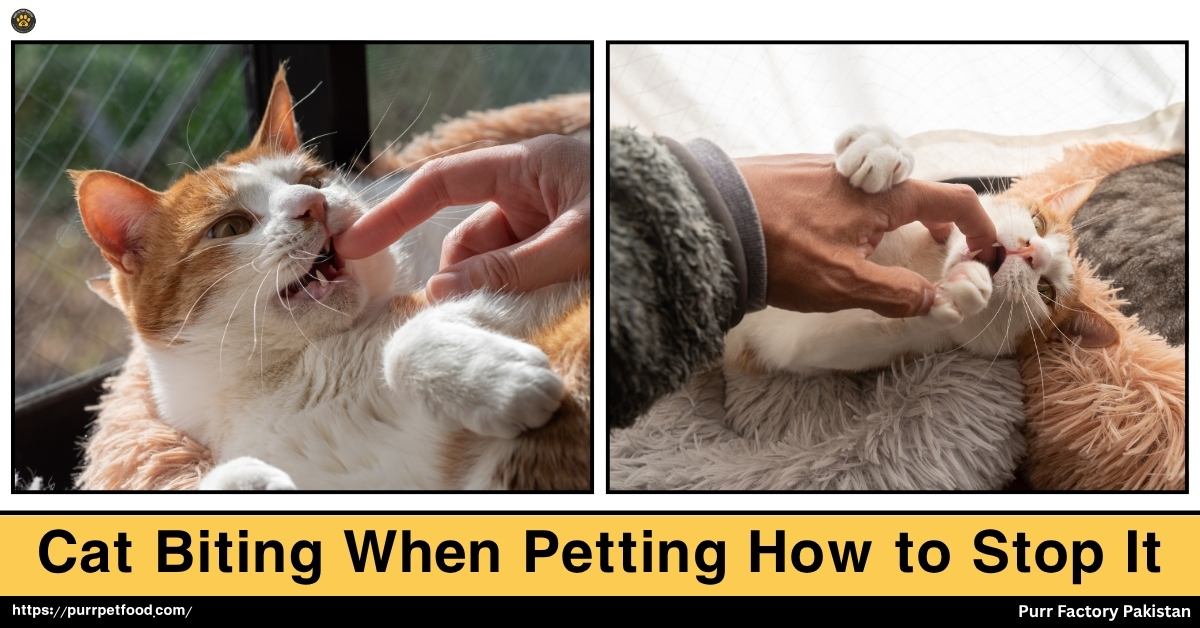
Why Do Cats Bite When Being Petted?
Cats bite when being petted for a variety of reasons, and understanding these reasons is the foundation of solving the problem. One of the most common explanations is overstimulation.
Cats have a lower tolerance for repetitive stroking compared to dogs. While the first few strokes may feel pleasant, continuous petting can cause their nervous system to react in a way that shifts from pleasure to irritation.
When this threshold is reached, the bite becomes a natural response to signal “enough.” This reaction is called petting-induced aggression, and it is well documented by veterinary behaviorists.
Another reason cats may bite during petting is related to play behavior and predatory instincts. Cats are natural hunters.
Even though they live indoors and receive Cat food from their owners, their hunting drive remains strong.
When a hand moves across their body in a certain way, especially near the belly or tail, it can trigger a play response.
What starts as petting may suddenly be interpreted as prey movement, leading the cat to grab and bite. This is more common in younger cats, who are naturally more energetic and playful.
Fear or anxiety is also a factor. Cats that were not properly socialized as kittens, or those who have had bad experiences with humans, may not fully trust physical contact.
While they may accept petting for a short period, the longer it continues, the more they feel threatened. The bite in this case is not about play but about self-defense.
Finally, medical issues cannot be ignored. Cats that suffer from arthritis, dental problems, or skin conditions may find certain touches painful.
When petting accidentally brushes against a sore spot, the cat may react by Cat biting to protect itself. Many owners mistake this for sudden aggression, when in reality it is a pain response.
This is why a change in biting behavior in an older cat or one that has always been calm before should be taken seriously and checked by a veterinarian.
What Not to Do When a Cat Bites
When faced with a biting cat, many owners react instinctively in ways that only make the situation worse. The first mistake is punishing the cat physically or verbally.
Hitting, tapping, or yelling at the cat creates fear and damages trust. Cats do not connect punishment with their biting behavior.
Instead, they associate the owner with danger, which leads to more stress and more defensive biting in the future.
Another common mistake is forcing petting after the bite. Some owners believe that if they continue to hold or stroke the cat, the animal will learn to tolerate it.
In reality, this escalates the aggression. A cat that feels trapped will fight harder to escape, often resulting in deeper bites and scratches.
Forcing interaction teaches the cat that hands are something to be feared rather than trusted.
It is also unhelpful to dismiss biting as a permanent trait of the cat. Many people assume that their cat is simply “mean” or “aggressive by nature.”
This belief prevents owners from exploring solutions that could improve the relationship. In most cases, biting is not a personality flaw but a communication issue that can be corrected with patience and the right approach.
The right reaction when a cat bites is to calmly stop the interaction and give the cat space. Ignoring the behavior rather than reacting strongly prevents reinforcement of the Cat biting.
Over time, the cat learns that biting does not bring attention or continuation of unwanted petting. This is a far more effective method than punishment or force.
How to Stop Cat Biting During Petting
Solving petting-related biting starts with understanding the cat’s individual tolerance levels. Every cat has a limit for how much contact they enjoy.
The key is to observe closely and end petting before the cat becomes overstimulated.
For example, if the cat shows signs such as tail flicking, skin twitching, or ears turning after a certain number of strokes, the owner should stop petting earlier, while the cat is still relaxed.
This prevents the interaction from reaching the point of a bite and helps the cat build positive associations with handling.
Another effective method is to focus on the cat’s preferred petting areas. Scientific studies show that most cats enjoy being stroked on the cheeks, chin, and base of the ears, while the belly and back are far less tolerated.
By keeping petting restricted to these areas, the risk of overstimulation is reduced. Owners should pay attention to their cat’s reactions and respect the zones that cause irritation.
Keeping petting sessions short is also important. Instead of continuous stroking for minutes at a time, owners can provide brief interactions with pauses in between.
Ending the session while the cat is still calm reinforces positive experiences. Treats can be given immediately after petting to strengthen the association between handling and rewards.
Over time, this reduces resistance and teaches the cat that petting leads to good outcomes.
For younger cats, biting is often a result of play energy. These cats need appropriate outlets for their natural instincts.
Interactive toys such as feather wands or kick toys allow them to bite and claw in a safe way. Daily play sessions also reduce excess energy, making them less likely to direct biting at their owners.
Puzzle feeders and food-dispensing toys can also provide mental stimulation, further lowering frustration.
Medical checks are a crucial step if the behavior is sudden or severe. Pain-related aggression can only be resolved by addressing the underlying health issue.
A veterinarian can check for arthritis, dental disease, skin conditions, or injuries that make handling uncomfortable. Once the pain is managed, the biting often decreases significantly.
Training with positive reinforcement is another long-term solution. Using a clicker or simple treats, owners can gradually condition the cat to enjoy petting.
For example, the cat can be rewarded after one stroke, then after two, slowly increasing the duration while keeping the experience positive. This method builds tolerance without force and encourages calm responses.
Data Snapshot: Cat Biting Statistics
Petting-related biting is not an unusual problem. Surveys of cat owners consistently show that more than half have experienced their cat biting during petting at some point.
A 2020 behavior survey revealed that 62 percent of cat owners reported being bitten in this context. The data also shows that age plays a role.
Cats between six months and two years of age are most likely to engage in play-biting during petting. This is consistent with their higher energy levels and strong hunting drive.
Other studies confirm that interactive play reduces biting incidents. Research published in feline behavior journals shows that cats who receive daily structured play sessions are up to 70 percent less likely to display petting-related aggression.
This supports the idea that many Cat biting behaviors are linked to unspent energy and lack of proper outlets for hunting instincts.
Health statistics also tie into the issue. Cornell University’s Feline Health Center reports that over 60 percent of cats above the age of six develop arthritis, often unnoticed by their owners.
Painful joints or sensitive areas make these cats more likely to bite when touched in certain spots. This highlights why veterinary checks should be considered a core part of addressing sudden biting behaviors.
Taken together, these statistics make one thing clear: biting during petting is not rare, not hopeless, and not simply “bad behavior.” It is a widespread issue with identifiable causes and proven methods of management.
Long-Term Success Tips
Achieving long-term success in stopping cat biting requires consistency and respect for the cat’s boundaries.
Owners must commit to observing their cat’s signals and adjusting their behavior accordingly.
If one family member ignores these rules and continues to over-pet or force contact, the progress made by others will be undone. Everyone in the household needs to follow the same approach.
Respecting a cat’s autonomy is also crucial. Cats are more relaxed when they feel they have control over interactions.
Allowing the cat to initiate contact instead of always starting petting on your own builds trust. When the cat chooses to approach, the chances of a positive session increase significantly.
Daily play is another long-term solution that cannot be skipped. A cat that regularly engages in hunting-style play is less likely to bite out of frustration or excess energy.
This also strengthens the bond between owner and cat, providing an alternative to biting as a form of interaction.
Reinforcing calm behavior is a subtle but powerful technique. Each time the cat allows petting without biting, the owner should respond with gentle praise, treats, or even ending the session before irritation sets in.
Over time, this conditions the cat to remain relaxed and expect good outcomes from handling.
In some cases, biting may never disappear completely. Certain cats will always have a low tolerance for extended petting.
However, with consistent management, the frequency and intensity of bites can be reduced to a manageable level.
The key is to create a household environment where the cat feels safe, respected, and understood. This not only reduces biting but also enhances the overall relationship between cat and owner.
Conclusion
Cats biting during petting is a behavior that often confuses owners, but it is rarely random. Most cases are linked to overstimulation, play instincts, fear, or medical discomfort.
The important point to remember is that biting is a form of communication, not an act of hostility. By paying close attention to body language and stopping petting before irritation builds, owners can prevent most bites.
Adjusting to a cat’s preferred touch zones, keeping interactions short, and offering alternative outlets like toys also reduces frustration.
Regular veterinary checks are essential, as pain or illness often explains sudden changes in tolerance. Consistency across all family members ensures the cat receives the same message and learns to trust interactions.
While some cats may never enjoy long petting sessions, most can learn to remain calm with patience and positive reinforcement.
Instead of punishment, focusing on respect and understanding creates long-term improvement. In short, managing cat biting is about communication, awareness, and care.