
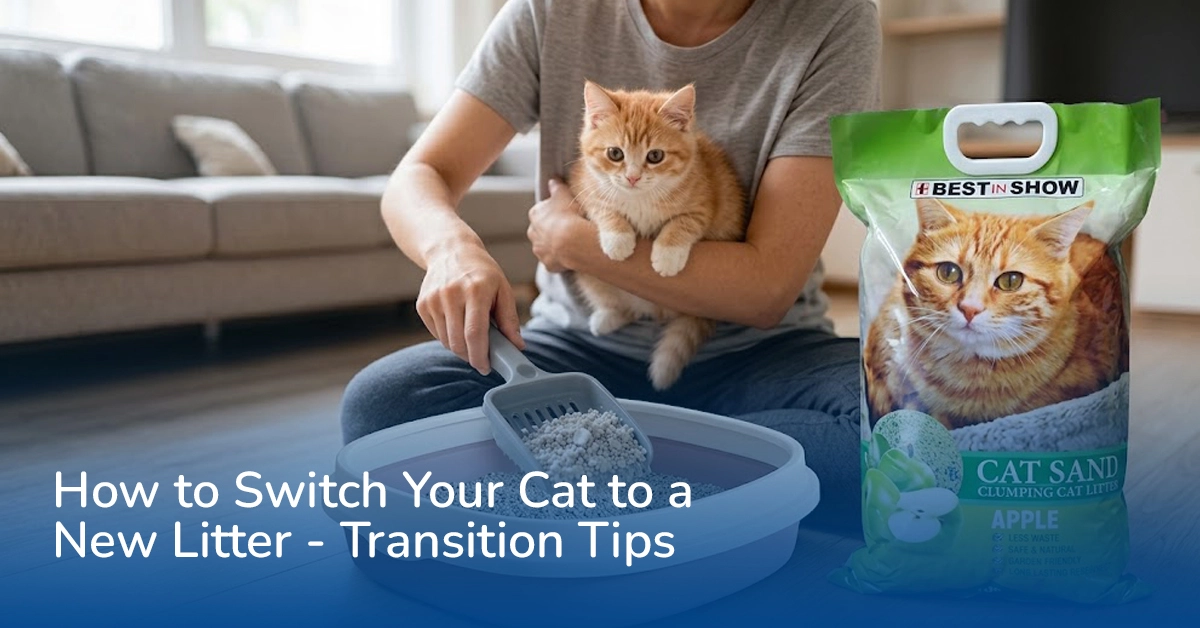
To switch your cat to a new litter, introduce it gradually instead of replacing the old litter all at once. Start by mixing a small amount of new litter with the familiar litter, then slowly increase the new portion over 7–14 days if your cat continues using the box comfortably. You can also offer the two litters in separate boxes, especially when switching between very different materials.
Changing cat litter might seem simple, but your cat may have other ideas. A new texture, unfamiliar smell, or different feeling beneath its paws can make an otherwise comfortable litter box less appealing.
Some cats adjust to a new brand within a few days. Others need more time, particularly when switching from fine-grain bentonite to larger tofu pellets or silica crystals.
Whether you’re changing litter to reduce dust, improve clumping, control odours, or try another material, the goal is the same: help your cat accept the new litter without disrupting its normal bathroom routine.
What’s the Best Way to Switch Cat Litter?
The best approach is to keep the litter box familiar while introducing the new material at a pace your cat accepts.
There are two practical methods:
- Gradual mixing: Add a small amount of new litter to the old litter and increase it over time.
- Side-by-side litter boxes: Provide one box with the familiar litter and another with the new litter so your cat can choose.
Gradual mixing can work well when the two materials have similar textures and compatible cleaning requirements.
Separate boxes may be better when changing between very different materials, such as fine bentonite and larger tofu pellets.
Neither method guarantees success. The right choice depends on your cat’s preferences and how it responds to the change.
Important: Never force your cat to use unfamiliar litter. If it begins avoiding the box, slow the transition and provide a familiar option.
Why Do Cats Sometimes Refuse New Litter?
Cats can be sensitive to changes in their bathroom environment. Even when a new litter looks better to you, your cat may dislike how it feels or smells.
Understanding these preferences can make changing cat litter much easier.
Different Texture or Granule Size
Texture is one of the biggest differences between cat litter materials.
A cat accustomed to fine, sand-like bentonite may hesitate when stepping onto larger pellets or crystals.
The unfamiliar surface can affect how comfortably the cat digs, turns around, and covers waste.
For example, switching directly from fine clay litter to tofu pellets changes both the material and the sensation beneath your cat’s paws.
What helps: Offer the new material gradually or provide a separate box where your cat can explore it without losing access to its familiar litter.
Strong Fragrance or Dust
Some cat litters contain added fragrances designed to make the surrounding area smell more pleasant.
However, a scent that appeals to people may be uncomfortable for a cat.
Similarly, differences in dust production can affect the litter box experience.
If your cat previously used unscented litter, a sudden switch to a strongly perfumed product may discourage it from entering the box.
What helps: Consider an unscented formulation with a comfortable texture, particularly if your cat appears sensitive to fragrances.
Too Many Changes at Once
Imagine replacing your cat’s litter, moving the box to another room, and introducing a covered tray on the same day.
If your cat refuses to use it, you won’t know which change caused the problem.
Cats often benefit from familiar routines and predictable access to their resources.
What helps: Change one factor at a time. Keep the existing box and location consistent while introducing new litter.
How to Switch Cat Litter Gradually (6 Easy Steps)
A successful cat litter transition is less about following a strict schedule and more about observing how your cat responds.
Step 1: Choose a Suitable New Cat Litter
Before making the switch, consider why you want to change the current litter.
Are you looking for:
- Better clumping performance?
- Less dust?
- Improved odour control?
- A different litter texture?
- An unscented alternative?
- A product that’s easier to find regularly?
Choose a litter that meets your practical needs without ignoring your cat’s comfort.
For example, if your cat already uses fine bentonite litter comfortably, switching to a similar unscented formulation may be easier than introducing a completely different pellet material.
Step 2: Keep the Existing Litter Box Familiar
During the transition, avoid changing the litter box itself unless necessary.
Keep the tray in its usual location and maintain your normal cleaning routine.
Your cat should still be able to enter, dig, and leave comfortably.
If you want to introduce a different box design, wait until your cat has adjusted to the litter change whenever possible.
This makes it easier to identify whether any hesitation is related to the new litter.
Step 3: Introduce a Small Amount of New Litter
If the two litter types can be mixed according to their product instructions, start with a small portion of the new material.
For example, you might use approximately:
- 75% familiar litter
- 25% new litter
Distribute the materials gently without making a sudden change to the litter depth.
Observe whether your cat continues entering the tray and using it normally.
If your cat appears uncomfortable or avoids the box, restore the familiar litter and consider a slower approach.
Note: Not all litter materials should be mixed. Some have different cleaning or moisture-handling requirements. Check the cat litter manufacturer’s guidance before combining them.
Step 4: Increase the New Litter Gradually
If your cat continues using the box comfortably, you can increase the new litter portion over several days.
For example, move from 25% new litter to 50%, then 75%, and eventually a complete replacement.
Don’t rush because a particular number of days has passed.
A cat that needs extra time should be allowed to adjust more slowly.
Step 5: Monitor Your Cat’s Behaviour
Watch how your cat responds each time the litter changes.
Positive signs include:
- Entering the litter box voluntarily
- Digging or covering waste normally
- Urinating and defecating as usual
- Returning to the box consistently
- Showing no obvious signs of discomfort
Possible signs of rejection include:
- Sniffing the litter and immediately leaving
- Avoiding the box repeatedly
- Using another location for urination or defecation
- Using only a separate box containing familiar litter
If your cat begins eliminating outside the box, don’t assume the new litter is the only possible cause. Medical problems can also affect litter box habits.
Emergency warning: If your cat repeatedly strains to urinate but produces little or no urine, seek emergency veterinary care immediately. Urinary blockage can be life-threatening, particularly in male cats.
Step 6: Complete or Pause the Transition
- Once your cat comfortably uses the new litter consistently, you can complete the transition.
- Continue cleaning the tray regularly and monitor for any changes.
- If your cat refuses the new material, pause the process rather than forcing it.
- Some cats may never accept a particular litter texture, and that’s okay.
The best litter is one that your cat will use comfortably and that you can maintain hygienically.
Cat Litter Transition Schedule: A 7–14 Day Example
The following schedule is a flexible starting point for compatible litter materials.
| Transition Period | Old Litter | New Litter | What to Observe |
| Days 1–3 | 75% | 25% | Does your cat enter and use the box normally? |
| Days 4–6 | 50% | 50% | Is your cat comfortable with the changing texture? |
| Days 7–10 | 25% | 75% | Are urination and defecation habits unchanged? |
| Days 11–14 | 0% | 100% | Is your cat consistently accepting the new litter? |
This is an example, not a fixed rule. Some cats may adjust more quickly, while others need several weeks.
If your cat becomes hesitant, return to the last accepted stage or provide a separate box with familiar litter.
Avoid continuing the schedule simply to meet a deadline.
Mixing Cat Litter vs. Using Two Litter Boxes
Not every litter transition requires mixing.
In some situations, offering two litter boxes can be more practical and comfortable for your cat.
When Gradual Mixing May Work
Mixing may be suitable when:
- You’re changing between similar litter formulations.
- Both products have compatible maintenance requirements.
- Your cat tolerates the mixed texture.
- You want to introduce a new brand gradually.
For example, moving between two similar clumping clay litters may require only a modest adjustment.
When Two Separate Boxes May Be Better
Side-by-side boxes may be useful when:
- Switching from fine clay to tofu pellets
- Introducing silica crystal litter
- Your cat has rejected a mixed litter
- You want to compare which material your cat prefers
- Multiple cats have different litter preferences
Place the boxes in accessible, appropriate locations and keep both clean.
Your cat can explore the new material while still having access to the familiar one.
| Method | Main Advantage | Possible Limitation |
| Gradual mixing | Introduces new material in stages | Not suitable for every litter combination |
| Two separate boxes | Allows your cat to choose | Requires additional space |
| Immediate replacement | Simple for the owner | May cause rejection in sensitive cats |
For most uncertain situations, preserving a familiar litter option is a sensible precaution.
How to Switch Between Different Cat Litter Types
Different litter materials have different textures, particle sizes, and maintenance requirements.
Understanding these differences helps you choose a suitable transition method.
Switching From Bentonite to Tofu Litter
Bentonite litter usually contains clay granules that absorb moisture and form clumps.
Tofu litter is generally made from processed plant-based materials and often comes in pellet-shaped particles.
The change in texture can be noticeable to your cat.
Transition tips:
- Keep the original bentonite litter available.
- Introduce tofu litter in a separate box if the textures are very different.
- Allow your cat to investigate the pellets voluntarily.
- Observe whether it digs and eliminates comfortably.
- Avoid removing the old litter until the new material is consistently accepted.
Don’t assume tofu litter is automatically better for every cat. Individual preferences and product performance vary.
Switching From Clay to Silica Crystal Litter
Silica crystal litter differs from traditional clay in both texture and moisture handling.
Some silica products absorb moisture without forming the same type of clumps as bentonite litter.
Because cleaning requirements can differ, using separate boxes may be more practical than mixing the materials.
Follow the instructions provided with the new litter.
Pay attention to whether your cat accepts the crystal texture and continues using the tray normally.
Switching From Scented to Unscented Litter
Some cats may prefer litter without added fragrances.
If you’re changing from scented to unscented litter of a similar material, the transition may be relatively straightforward.
However, differences in particle size and formulation can still affect acceptance.
Introduce the new litter gradually and observe your cat’s response.
If your cat has already been avoiding a strongly scented product, offering a separate clean box with unscented litter may help you assess its preference.
What If Your Cat Refuses the New Litter?
A cat refusing new litter doesn’t necessarily mean you’ve done something wrong.
It may simply dislike the texture, scent, or other characteristics.
However, persistent litter box avoidance can also indicate a health problem.
Use the following table to decide what to do next.
| What You Notice | Possible Explanation | What to Do |
| Cat sniffs the new litter and walks away | Unfamiliar scent or texture | Offer familiar litter and slow the change |
| Cat only uses the old litter box | Strong preference for familiar material | Keep both boxes available |
| Cat hesitates before digging | Different texture or box preference | Observe and reduce unnecessary changes |
| Cat urinates outside the box | Litter aversion or medical condition | Arrange veterinary assessment |
| Cat stops defecating normally | Possible digestive discomfort or avoidance | Contact a veterinarian |
| Cat strains but cannot urinate | Possible urinary obstruction | Seek emergency veterinary care |
| One cat accepts the litter, another refuses | Individual preferences | Provide separate litter options |
Don’t Punish Your Cat
Never scold, frighten, or physically force your cat into the new litter box.
Punishment can increase stress and create negative associations with the tray.
Instead, restore a familiar option and investigate why your cat is uncomfortable.
Avoid Repeatedly Changing Products
Switching from one unfamiliar litter to another every few days can make the situation harder to understand.
If your cat rejects a new material, return to an accepted setup and identify the likely cause before trying another change.
Special Tips for Kittens, Senior Cats, and Multi-Cat Homes
Not every cat has the same needs during a litter transition.
Changing Litter for Kittens
Kittens are still developing their litter box habits.
Choose an age-appropriate material and an easily accessible tray.
Very young kittens may require special consideration regarding litter ingestion and material safety, so follow veterinary cat litter guidance and product age recommendations.
Avoid introducing several unfamiliar litter types while a kitten is still learning to use the box consistently.
Switching Litter for Senior Cats
Older cats may have established preferences and may be less comfortable with sudden changes.
Mobility problems can also make a litter box difficult to access.
Keep the tray in a familiar location and ensure the entrance is comfortable.
If an older cat suddenly stops using the box, arrange a veterinary assessment rather than assuming the new litter is responsible.
Changing Litter in Multi-Cat Households
When several cats share a home, one may accept a new litter while another refuses it.
Don’t replace every box with the new material at once.
Provide enough separate litter boxes and preserve familiar options.
A common starting recommendation is one litter box per cat, plus one additional box, distributed across suitable locations.
Observe each cat individually instead of assuming that all cats have the same preference.
How to Choose New Cat Litter in Pakistan
Cat owners in Pakistan can find different litter materials, including locally manufactured bentonite, imported clay formulations, and alternative materials.
The right choice depends on your cat’s preferences, household needs, and product availability.
1. Consider Litter Texture
If your cat already uses fine-grain clay litter comfortably, a similar texture may be easier to introduce than large pellets.
However, some cats readily accept different materials.
Your cat’s response matters more than general assumptions.
2. Compare Clumping Performance
Good clumping performance can make daily cleaning easier.
Firm, removable clumps help owners remove urine-soaked material without replacing the entire tray unnecessarily.
Clumping quality varies between brands and formulations.
3. Check Fragrance and Dust Levels
Strong fragrances may discourage some cats from using the box.
Dust levels also vary by product.
If your cat appears sensitive to a particular formulation, consider a different option while keeping its familiar litter available during the transition.
4. Think About Tracking and Cleaning
Some litter materials may stick to paws or scatter more easily than others.
Particle size, weight, litter box design, and your cat’s digging behaviour all influence tracking.
If tracking is your main reason for switching, compare litter characteristics rather than assuming one material will eliminate the problem.
5. Choose Litter You Can Buy Consistently
Availability matters, especially when your cat has a strong preference for a particular material.
If you frequently switch brands because the usual litter is unavailable, your cat may need to adjust repeatedly.
Choosing a reliably available product can help maintain a consistent routine.
For cat owners in Karachi, Purr Pet Food offers different cat litter options to compare based on material, fragrance, and everyday cleaning needs.
You can explore the cat litter collection before deciding which formulation to introduce.
Common Mistakes When Changing Cat Litter
Replacing All the Litter Overnight
A sudden change can make the tray unfamiliar, especially when the new material has a different texture or fragrance.
Introduce it gradually or provide a separate box.
Changing the Litter Box at the Same Time
Replacing the litter, moving the tray, and changing its design simultaneously makes it difficult to identify what your cat dislikes.
Keep other parts of the setup consistent.
Ignoring Signs of Rejection
If your cat repeatedly avoids the new litter, don’t continue increasing it.
Pause the transition and restore an accepted option.
Assuming Every Litter Type Can Be Mixed
Different materials may have incompatible maintenance requirements.
Check manufacturer instructions before combining products.
Choosing Litter Only for Fragrance
A pleasant smell for humans doesn’t necessarily mean the litter is comfortable for cats.
Prioritize acceptance, hygiene, and appropriate material characteristics.
Forcing Your Cat to Adjust Quickly
There is no universal deadline for a successful litter transition.
Some cats need more time, while others may never accept a particular material.
Final Thoughts: Make Cat Litter Changes Comfortable
Learning how to switch cat litter is about more than mixing two products.
The most important part is understanding your cat’s preferences and introducing changes without removing its access to a familiar, comfortable litter box.
Start slowly, observe how your cat responds, and adjust the process when needed.
Whether you’re switching from bentonite to tofu litter, trying an unscented formula, or choosing a different brand, comfort and consistent litter box use should come first.
At Purr Pet Food, we believe everyday cat care should be simple and practical. If you’re planning to change your cat’s litter, compare the available materials and choose a product that suits your cat’s needs and your cleaning routine.