
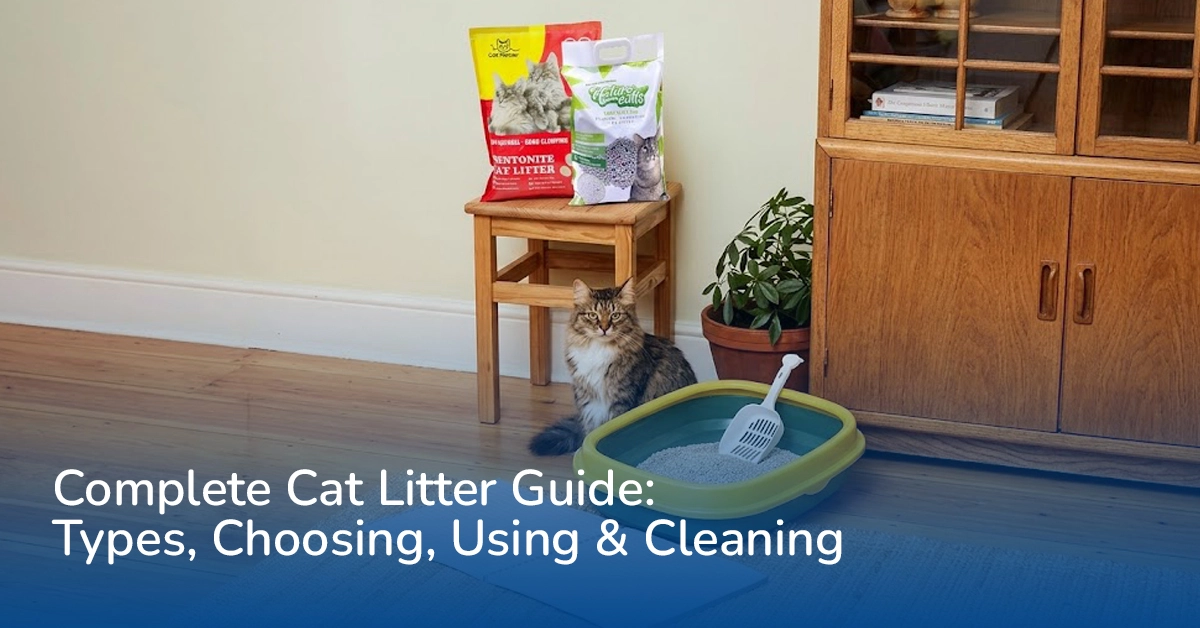
Choosing cat litter may seem simple until you start comparing clumping, non-clumping, scented, unscented, bentonite, crystal, tofu, and other options. The right litter depends on your cat’s preferences, your household size, cleaning routine, and priorities such as odor control, clumping strength, dust, tracking, and cost.
This cat litter guide explains the main types of litter, how to choose the right one, how much to put in the litter box, how often to scoop and change it, and how to solve common problems such as smell, tracking, and litter-box avoidance.
Cat litter is an absorbent material placed inside a litter box or tray to collect urine and feces while giving cats a suitable surface for digging and covering their waste.
A good litter should balance several qualities:
There is no single litter that is best for every cat.
A better decision process is:
Cat Preference + Household Needs + Litter Performance + Cleaning Routine = Suitable Cat Litter
Cat litter can be classified by both its material and how it handles moisture. Understanding these differences makes choosing a suitable option much easier.
Bentonite is one of the most common materials used in clumping litter.
When exposed to moisture, bentonite absorbs liquid and binds together:
Moisture → Absorption → Binding → Scoopable Clump
Its main advantages can include:
However, weight, dust, tracking, granule size, and fragrance can vary considerably between formulas.
For cat owners looking for this type specifically, compare Purr Pet Food’s imported bentonite cat litter options.
Crystal litter is usually made from highly absorbent silica-based granules.
Instead of behaving exactly like traditional clay litter, the crystals absorb moisture differently.
Potential advantages include:
However, texture can feel very different from clay, and individual cats may or may not accept it.
Tofu litter is generally made using plant-derived material such as soybean fiber.
Depending on the formula, it may offer:
Clumping strength, dust, tracking, availability, and cost vary by brand.
Wood-based litter commonly uses compressed wood or pine material.
Some products come as pellets, while others use finer particles or clumping formulations.
The texture is noticeably different from conventional clay, so cats accustomed to fine litter may require a gradual transition.
Corn and other plant-derived materials are also used to produce absorbent and, in some cases, clumping litter.
Performance depends heavily on the formulation rather than simply whether the litter is plant-based.
Compare:
before choosing one.
Paper litter is generally produced from processed paper material and often comes as pellets.
It provides another alternative to clay-based products, although its absorption and clumping behavior can be very different.
The most appropriate option depends on your cat and the reason you are considering it.
| Litter Type | Clumping | Weight | Dust | Tracking | Key Consideration |
| Bentonite/Clay | Usually strong | Heavier | Varies | Varies | Strong scoopability |
| Silica Crystal | Formula-dependent | Often lighter | Varies | Varies | Absorption |
| Tofu | Often clumping | Usually lighter | Varies | Varies | Plant-based option |
| Wood/Pine | Formula-dependent | Varies | Varies | Varies | Different texture |
| Corn/Plant-Based | Often available as clumping | Often lighter | Varies | Varies | Cost and availability |
| Paper | Usually non-clumping | Light | Often lower | Varies | Specialized use |
The material alone does not determine whether a litter will work well. The individual formula and your cat’s response matter just as much.
One of the biggest decisions is clumping vs non clumping cat litter.
Clumping litter absorbs urine and forms a removable mass.
The process is:
Urine → Absorption → Clump Formation → Scooping
This allows you to remove soiled material without replacing all the clean litter every time your cat urinates.
Strong clumping is particularly useful for owners who scoop frequently.
Non-clumping litter absorbs moisture but does not form the same firm, removable urine clumps.
That means its maintenance and replacement routine can differ from clumping litter.
Neither option is automatically right for every cat.
Clumping litter may be preferable when you prioritize:
Non-clumping litter may suit specific cats, products, life stages, or household preferences.
For more detail, read about the best clumping cat litter and how clumping formulas work.
Another common decision is scented vs unscented cat litter.
Scented litter contains added fragrance intended to change or mask the perceived smell around the litter box.
Some owners like fragrance, while some cats may be less comfortable with strong scents.
Unscented litter does not depend on added perfume to mask litter-box odor.
It may be preferable when a cat or household member dislikes strong fragrance.
Most importantly:
Fragrance is not the same as odor control.
Actual odor management depends on:
Absorption + Waste Removal + Clean Litter + Box Hygiene + Ventilation
A strongly perfumed dirty litter box is still a dirty litter box.
Instead of looking for one universally “best” product, compare litter using the attributes that affect everyday use.
If you choose clumping litter, look at how well the clump stays together during scooping.
Weak clumps can break into smaller soiled pieces and mix back into clean litter.
Litter needs to absorb moisture efficiently.
With clumping litter, good absorption can help contain urine before it spreads across the bottom of the box.
Look for odor management that works with your cleaning routine rather than expecting fragrance alone to solve the problem.
The Dust can occur while:
Dust levels vary even between products made from similar materials.
Tracking occurs when litter particles leave the box on a cat’s paws or fur.
Granule size, weight, box design, litter depth, digging behavior, and mats can all affect it.
Your cat has a vote too.
A litter can perform extremely well for the owner but fail if the cat dislikes its:
One cat and four cats place very different demands on litter.
More cats usually mean:
More Box Use → More Waste → Faster Odor Accumulation → Greater Litter Consumption
Do not compare products using bag price alone.
A better formula is:
Pack Price ÷ Pack Size = Basic Unit Cost
Then consider:
Unit Cost + Litter Lost During Scooping + Replacement Frequency = Practical Cost
A cheaper litter is not necessarily better value if weak clumps cause large amounts of clean litter to be discarded.
The best clumping cat litter should form firm, scoopable clumps without requiring large amounts of clean litter to be removed.
Look for a balance of:
For many households, bentonite litter is popular because of its strong moisture-binding properties. However, the individual formulation still matters.
Do not choose based only on claims such as “premium,” “ultra,” or “multi-cat.” Compare how the litter actually meets your household’s requirements.
The best cat litter for multiple cats should cope with heavier use while remaining easy to clean.
Prioritize:
But litter performance is only one part of managing several cats.
A multi-cat household also needs enough clean, accessible boxes.
For a deeper comparison, see our guide to the best cat litter for multiple cats.
If you’re wondering how much cat litter to put in litter box, start with the litter manufacturer’s instructions and adjust according to the litter type, box, and your cat’s digging habits.
Depth matters because too little or too much litter can create different problems.
A shallow layer may allow urine to reach the bottom before it is fully absorbed.
That can cause:
Excessive depth can:
The goal is enough depth for your cat to dig and cover waste while allowing the litter to perform properly.
Top up the box after scooping when necessary rather than allowing the litter level to become progressively shallower.
Waste should be removed regularly.
For most households, check the litter box at least daily. Heavily used boxes or multi-cat homes may need more frequent scooping.
The right schedule depends on:
Number of Cats + Number of Boxes + Actual Box Usage
Remove:
Regular scooping also lets you notice changes in your cat’s litter-box habits.
A suitable cat litter scoop can make removing firm clumps easier.
There is no single answer to how often to change cat litter because litter types and household conditions differ.
It helps to separate three tasks.
Removing urine clumps and feces.
This is the most frequent task.
Adding fresh litter to replace material removed during scooping.
This helps maintain suitable depth.
Removing the remaining litter and replacing it with fresh material.
How often this is necessary depends on:
Do not wait for an overpowering smell before maintaining the box.
Knowing how often to clean litter box also requires distinguishing daily scooping from washing the actual tray.
Remove waste and visibly soiled litter.
When performing a full litter change:
Avoid leaving strong perfume or cleaning-product residue that could discourage your cat from using the box.
Replace damaged boxes when deep scratches or worn surfaces become difficult to maintain.
If you want to know how to stop cat litter from smelling, start with waste removal rather than perfume.
Use this approach:
Frequent Scooping → Enough Boxes → Suitable Litter → Correct Depth → Regular Cleaning → Better Odor Control
Removing waste prevents odor from accumulating.
Several cats sharing too few boxes can quickly overwhelm even high-performing litter.
Top up clean litter as needed.
When the remaining litter becomes heavily contaminated or difficult to maintain, perform a full change.
Old residue can continue to smell even after fresh litter is added.
If odor remains difficult to control despite good maintenance, compare another litter formula.
Scented litter can change how the area smells, but it should not replace cleaning.
Tracking happens when litter leaves the box on your cat’s paws or fur.
The relationship is often:
Litter Particles + Digging + Paw Contact + Box Exit → Tracking
If you want to know how to reduce cat litter tracking, try combining several approaches.
Very light or fine particles may travel differently from heavier granules.
Place an appropriate mat around the main exit from the litter box.
A higher-sided or appropriately designed box may reduce the amount kicked outside during digging.
More litter is not always better.
Even low-tracking litter will not eliminate every particle.
A cat not using litter box should not automatically be described as badly behaved.
Possible causes include:
Litter-Box Avoidance
→ Dirty Box
→ Litter Texture
→ Fragrance
→ Sudden Litter Change
→ Box Size
→ Box Location
→ Multi-Cat Conflict
→ Stress
→ Medical Problem
Start by checking whether anything recently changed.
Ask:
A sudden or persistent change in litter-box habits can have a medical cause. Contact a veterinarian, particularly if your cat shows straining, discomfort, frequent attempts to urinate, blood, unusual vocalization, or other signs of illness.
If you are learning how to switch cat litter, remember that cats can be sensitive to changes in texture and scent.
For cats that dislike sudden changes, use a gradual transition:
Existing Litter → Introduce New Litter → Gradually Increase → Monitor Cat
During the transition, watch for:
If your cat readily accepts the new litter, the transition may be straightforward. If not, slow the process down.
Do not make several major litter-box changes at the same time if you can avoid it. Otherwise, it becomes difficult to identify what your cat dislikes.
A commonly used starting guideline is:
One Litter Box per Cat + One Additional Box
For example:
| Number of Cats | Common Starting Point |
| 1 | 2 boxes |
| 2 | 3 boxes |
| 3 | 4 boxes |
| 4 | 5 boxes |
Treat this as a guideline rather than a rigid law.
Consider:
Where possible, distribute boxes across accessible areas rather than placing every box directly beside the others.
You can explore suitable litter boxes for different household setups.
Choose a location that is:
Avoid locations where another pet can easily prevent the cat from entering or leaving.
For multi-cat homes, box distribution becomes particularly important because one cat may be uncomfortable sharing a particular location.
The appropriate litter for a kitten can depend on age, behavior, and product instructions.
Very young kittens may investigate their environment by chewing or attempting to eat unfamiliar material.
Always check the litter manufacturer’s age guidance and ask your veterinarian if you are unsure what is appropriate for a young kitten.
Repeated litter eating should not simply be treated as a preference issue.
Follow the manufacturer’s instructions and local waste-disposal requirements.
Do not assume that a litter marketed as plant-based, biodegradable, or flushable is appropriate for every plumbing and wastewater system.
A safer general approach is to:
Product-specific instructions should take priority.
For cat owners in Pakistan, price matters but the cheapest bag is not necessarily the lowest-cost litter to use.
Compare:
How much does the full bag cost?
Compare kg or liters rather than bag appearance.
How quickly does your household use it?
Does scooping remove a compact clump or a large amount of surrounding clean litter?
How frequently does the remaining litter need replacement?
A multi-cat household will generally consume more litter.
The practical equation is:
Pack Cost + Consumption + Waste per Scoop + Replacement Frequency = Real Household Cost
Purr Pet Food offers both imported and locally manufactured options, giving cat owners another useful comparison point when shopping for cat litter.
Do not assume imported automatically means better or local automatically means cheaper.
Compare actual attributes such as:
For a household using several boxes, consistent availability may be just as important as a small performance difference.
Consider cost per use rather than just bag price.
A very shallow layer can lead to sticking and poor clump formation.
Waste removal matters more.
The owner and cat both need to be comfortable with the product.
Some cats need time to accept a different texture or scent.
Fresh litter cannot compensate indefinitely for accumulated waste.
Heavy sharing can contribute to hygiene and accessibility problems.
A behavior change can sometimes indicate stress or a health problem.
The best cat litter is not simply the most expensive, most heavily scented, or most aggressively marketed product. It is the option that balances your cat’s preference, reliable litter performance, easy maintenance, household requirements, and practical cost.
WhatsApp us