
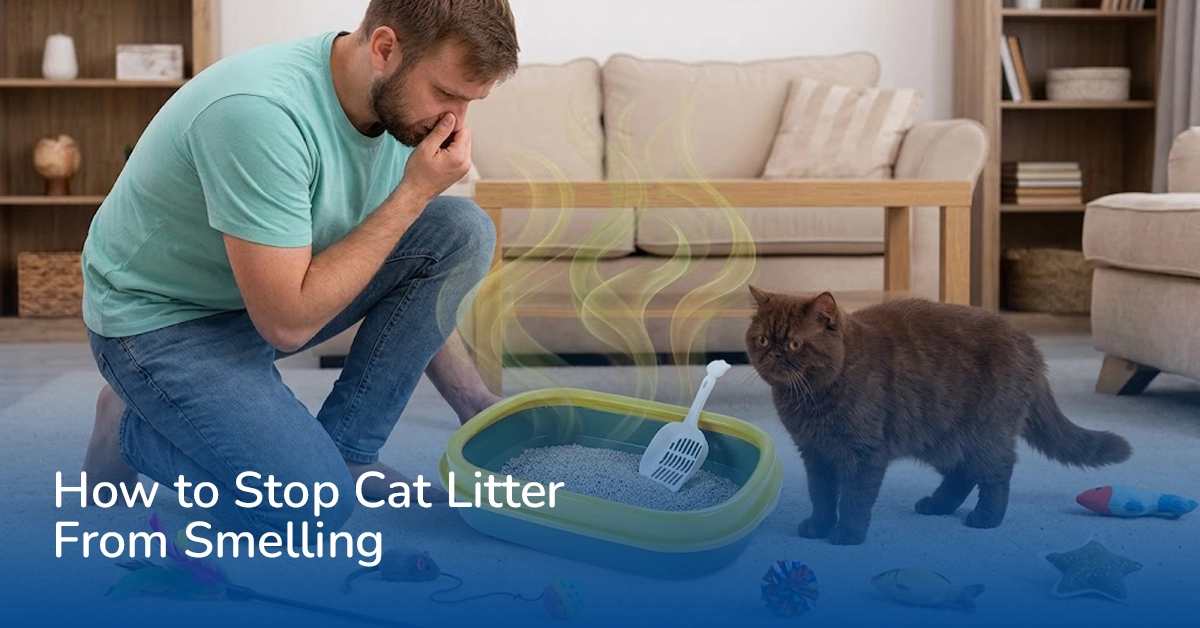
To stop cat litter from smelling, scoop urine clumps and solid waste at least once a day, use absorbent litter that forms firm clumps, and clean the litter box regularly. Keep the box in a well-ventilated area and replace litter when it becomes saturated. These simple habits can make a noticeable difference in controlling unpleasant odours.
If you’ve ever walked into a room and noticed a strong smell coming from your cat’s litter box, you’re not alone. Even a clean-looking litter tray can develop unpleasant odours, especially when urine collects at the bottom or the litter doesn’t absorb moisture properly.
For cat owners in Pakistan, hot weather, humidity, and limited space in apartments can make litter box maintenance more challenging.
The good news is that you don’t need expensive equipment or strong fragrances to keep your cat’s litter box fresh. The key is understanding where the smell comes from and dealing with the cause rather than covering it up.
If your cat’s litter box already smells bad, start with these five steps:
If the tray continues to smell after cleaning, the problem may be the litter itself, the condition of the box, or a change in your cat’s health.
Cat litter develops unpleasant odours mainly because of urine, faeces, moisture, and waste that remains in the litter box.
Even litter advertised for odour control can start smelling when it becomes saturated or isn’t cleaned frequently enough.
Fresh cat urine contains urea and other waste products. As urine sits in the litter box, microorganisms can break down urea and produce ammonia, which has a sharp, unpleasant smell.
The longer urine remains in the box, the more noticeable the odour can become.
This is why removing urine-soaked litter is more effective than simply spraying an air freshener nearby.
Clumping cat litter is designed to absorb moisture and form removable clumps.
However, not all litter performs the same way.
Some products form firm clumps that are easy to scoop. Others may break apart, leaving small urine-soaked particles behind.
Over time, these particles can accumulate and produce a persistent smell.
If you notice wet patches underneath apparently dry litter, the material may not be absorbing urine effectively.
A litter box can retain smells even after the visible waste has been removed.
Urine residue may remain along the sides, in scratched plastic surfaces, or underneath the litter.
Poor ventilation can make the smell more noticeable, especially in small rooms.
In Karachi and other parts of Pakistan, warm or humid conditions may also make it harder to keep litter dry.
Regular scooping is one of the most effective ways to control litter box odour.
Remove solid waste and urine clumps at least once daily. Twice-daily scooping may be helpful when several cats share a home or the box becomes dirty quickly.
Use a litter scoop that separates clean litter box from clumps without breaking them apart.
Practical tip: Don’t shake the scoop aggressively. Fragile urine clumps can crumble and mix back into the clean litter.
For more information about how clumping works, read our guide to the benefits of clumping cat litter.
A very shallow layer of litter may allow urine to reach the bottom of the tray before it is fully absorbed.
For many clumping clay litters, a depth of approximately 5–7 cm (2–3 inches) is a reasonable starting point, although you should follow the manufacturer’s recommendations and consider your cat’s preferences.
Check the depth after scooping and add fresh litter when needed.
Avoid overfilling the box. Too much litter can make digging messy and increase tracking around the room.
Topping up litter is useful, but it doesn’t replace proper maintenance.
Over time, even good-quality litter can become contaminated with small waste particles, moisture, and residue.
How often you need a complete change depends on:
Some clumping litters can be maintained longer with regular scooping, while clumping vs non clumping cat litter materials may require more frequent replacement.
Important: If the litter is damp throughout or has a persistent smell after scooping, replace it rather than simply adding more on top.
Even after removing the litter, odour-causing residue can remain on the tray.
When a full clean is needed:
Avoid harsh fragrances, strong disinfectants, and products containing ammonia.
Never mix bleach with ammonia or other cleaning chemicals. Dangerous fumes can result.
If the plastic box has deep scratches that repeatedly trap residue, replacing it may be more effective than washing it again.
The litter you use plays an important role in managing smell.
A suitable product should absorb moisture, make waste easy to remove, and be comfortable for your cat.
When comparing litter products, consider:
For cat owners comparing local options, Purr Pet Food offers a selection of Pakistan-manufactured cat litter.
Choose a product based on its characteristics and your cat’s needs, rather than fragrance alone.
Litter box placement affects both odour control and your cat’s willingness to use it.
Choose a location with reasonable airflow, privacy, and easy access.
Avoid placing the box in a completely enclosed cupboard where moisture and smells can accumulate.
At the same time, don’t put it somewhere noisy, unsafe, or difficult for your cat to reach.
For small apartments, a quiet bathroom or utility area may work if the door remains accessible and the room is adequately ventilated.
Avoid placing litter boxes close to food preparation areas or your cat’s feeding station.
A heavily perfumed litter box may smell pleasant to you, but that doesn’t necessarily mean it’s clean.
Strong fragrances can mask waste odours rather than remove their source.
Some cats also dislike heavily scented litter or cleaning products.
If your cat starts avoiding the box after a litter change, fragrance or texture could be one possible reason.
Unscented litter with effective absorption and regular waste removal may be a better choice for fragrance-sensitive cats.
If you prefer scented litter, introduce it gradually and observe your cat’s behaviour.
When several cats share one litter box, waste accumulates more quickly.
This can make the box smell stronger and may create competition or stress between cats.
A commonly recommended starting point is one litter box per cat, plus one additional box.
For example:
| Number of Cats | Suggested Starting Number of Boxes |
| 1 cat | 2 boxes |
| 2 cats | 3 boxes |
| 3 cats | 4 boxes |
| 4 cats | 5 boxes |
The exact setup depends on your home, available space, and your cats’ behaviour.
Place boxes in accessible locations rather than grouping all of them together in one crowded area.
Sometimes the smell isn’t coming from the litter itself.
Urine may splash onto the tray’s exterior, or a cat may accidentally urinate over the edge.
Dirty litter mats, nearby flooring, and trapped litter particles can also retain odours.
Inspect the surrounding area when cleaning the box.
Use a pet-safe cleaning product suitable for the surface. For urine accidents outside the tray, an appropriate enzymatic cleaner can help break down organic residues when used according to its label.
Don’t use strong perfume to cover the smell.
If your cat’s litter suddenly smells much stronger than usual, pay attention to changes in urination, stool, and behaviour.
A strong smell alone doesn’t diagnose a medical problem, but unusual symptoms deserve attention.
Contact a veterinarian if you notice:
Emergency warning: If your cat repeatedly tries to urinate but produces little or no urine, seek emergency veterinary care immediately. Urinary blockage can be life-threatening, particularly in male cats.
There isn’t one litter type that works best for every cat.
The right choice depends on absorbency, clumping performance, cleaning habits, and your cat’s preferences.
Bentonite is a clay material commonly used in clumping cat litter.
When urine comes into contact with suitable clumping bentonite, the material absorbs moisture and forms a clump that can be removed.
Potential advantages:
Things to consider:
For households dealing with persistent urine odour, clump strength is often more important than how strongly the litter is scented.
Silica crystal litter is designed to absorb moisture and help manage odours.
Unlike traditional clumping clay, many crystal litters use a different maintenance process.
Depending on the product, owners may need to remove solid waste, stir the crystals, and replace the litter when it becomes saturated.
Potential advantages:
Things to consider:
Tofu litter and other plant-based alternatives are typically made from processed plant materials.
Some formulations clump, while others work differently.
Their performance varies depending on the ingredients and manufacturing process.
Potential advantages:
Things to consider:
Do not flush used litter down the toilet unless local wastewater rules and product guidance explicitly permit it. Bagging and disposing of waste appropriately is generally the safer option.
Scented litter contains added fragrance, while unscented litter does not rely on perfume to provide a pleasant smell.
Neither option automatically guarantees better odour control.
| Feature | Scented Litter | Unscented Litter |
| Added fragrance | Yes | No |
| Masks some smells | May do so | Does not rely on fragrance |
| Suitable for fragrance-sensitive cats | May be less suitable | Often preferable |
| Needs regular scooping | Yes | Yes |
| Odour performance | Depends on formulation | Depends on formulation |
Our recommendation: Prioritise effective absorption, firm clumping, and your cat’s comfort. Treat fragrance as a preference, not a replacement for cleaning.
A consistent routine is usually more effective than waiting until the litter box starts smelling.
The following schedule is a practical starting point, not a fixed rule for every litter product.
| Frequency | What to Do |
| Every day | Scoop urine clumps and faeces; check for wet spots |
| Twice daily, if needed | Scoop again for heavy use or multiple cats |
| Every few days | Check litter depth, tray edges, mat, and surrounding floor |
| During routine full changes | Empty, wash, rinse, dry, and refill the tray |
| Whenever litter becomes saturated | Replace contaminated litter |
| Regularly | Inspect the box for scratches, leaks, or trapped residue |
High temperatures can make unpleasant smells more noticeable, while humid conditions may contribute to damp litter.
During hot or humid weather:
For Karachi cat owners, a dry, ventilated indoor location is usually more practical than an exposed balcony.
Living in a small apartment doesn’t mean you have to tolerate litter box odours.
The challenge is finding a location that works for both you and your cat.
Look for a quiet area with airflow and enough room for your cat to enter, turn around, and dig comfortably.
Avoid placing the box beside your bed or near food preparation areas if another suitable location is available.
A bathroom can work, provided it remains accessible and doesn’t become excessively humid.
Enclosed litter furniture may hide the box from view, but it can also trap moisture and smells.
If you use an enclosure, ensure adequate ventilation and monitor whether your cat is comfortable using it.
A convenient cleaning setup makes daily scooping easier.
Use a suitable waste bag or covered disposal container and empty it regularly.
Avoid storing uncovered cat waste inside the home.
Some cats prefer open litter boxes, while others tolerate covered designs.
A box that looks attractive to you may not be comfortable for your cat.
If your cat avoids a new box or enclosure, reassess its size, location, and accessibility.
Most litter box odours are related to ordinary waste accumulation and maintenance.
However, a sudden change in smell accompanied by unusual behaviour can sometimes indicate a health concern.
Changes in urination frequency, volume, or comfort may be associated with urinary tract problems or other medical conditions.
Don’t assume that stronger-smelling urine simply means your cat needs different litter.
Dietary changes, digestive problems, and other health conditions can affect stool consistency and smell.
If diarrhoea continues or your cat appears unwell, consult a veterinarian.
Changing litter or using deodorising products cannot treat urinary blockage, infection, or other medical conditions.
Seek professional veterinary guidance when symptoms suggest a medical problem.
Keeping cat litter from smelling doesn’t require complicated cleaning methods or heavily scented products.
The most effective approach is to remove waste regularly, use litter that absorbs moisture well, keep the box clean, and maintain good airflow.
If odours return quickly, check whether urine is collecting underneath the litter or whether the material is breaking apart during scooping.
For cat owners in Pakistan, especially those living in warm or humid conditions, a consistent cleaning routine can make litter box maintenance much easier.
At Purr Pet Food, we understand that choosing suitable litter is an important part of keeping your cat comfortable and your home clean.
WhatsApp us