
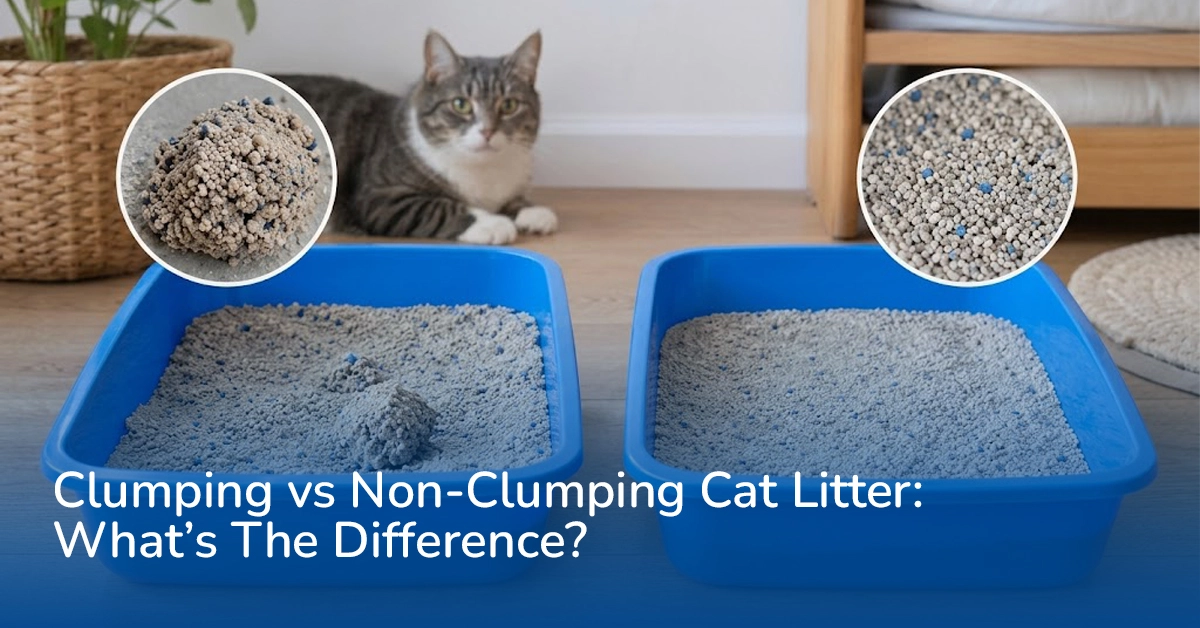
The main difference between clumping vs non clumping cat litter is how each handles urine. Clumping litter absorbs moisture and binds wet particles into a removable clump, while non-clumping litter absorbs urine without creating the same firm, scoopable mass.
Neither type is automatically best for every cat. The right choice depends on your cat’s preference, cleaning routine, number of cats, odor-control needs, litter material, and budget.
Understanding this difference makes it much easier to choose the right cat litter for your home.
Here is the basic difference at a glance.
| Feature | Clumping Cat Litter | Non-Clumping Cat Litter |
| Urine handling | Forms removable clumps | Absorbs urine without the same firm clump |
| Daily cleaning | Scoop urine clumps and feces | Remove feces and maintain absorbed litter |
| Topping up | Usually needed after scooping | Depends on product and maintenance |
| Full replacement | Depends on usage and condition | Depends on usage and product |
| Odor management | Helps remove urine-soiled litter | Depends heavily on absorption and replacement |
| Litter consumption | Clean litter can remain after scooping | Different replacement pattern |
| Dust | Depends on material/formula | Depends on material/formula |
| Tracking | Depends on granule size/formula | Depends on granule size/formula |
| Multi-cat use | Often convenient for frequent scooping | Can work depending on formula/routine |
| Cat preference | Individual | Individual |
The important point is that clumping ability is only one characteristic of cat litter. Material, dust, tracking, fragrance, texture, absorption, and cat acceptance still matter.
Clumping cat litter is designed to bind together when it comes into contact with moisture.
When your cat urinates:
Liquid Contact → Moisture Absorption → Particles Bind → Scoopable Clump
Instead of replacing all the litter after each use, you can remove the urine clump along with feces and leave much of the clean litter in the box.
Fresh litter can then be added to maintain an appropriate level.
This targeted cleaning process is one of the main reasons clumping litter is widely used in everyday litter-box maintenance.
Bentonite clay is a common material used in clumping litter because of its moisture-absorbing and binding properties.
However:
Clumping Litter ≠ Bentonite Only
Plant-derived materials such as tofu, corn, and other formulations may also be manufactured as clumping litter.
The individual product determines its:
If you prefer clay-based formulas, you can compare Purr Pet Food’s imported bentonite cat litter options.
Non-clumping litter absorbs urine but does not create the same firm, removable urine clump.
The process is closer to:
Urine → Absorption → Moisture Held by Litter → No Firm Scoopable Clump
Feces can still be removed regularly, but urine-soiled litter is managed differently.
As the litter continues to absorb moisture, its condition, odor, and cleanliness need to be monitored. The litter is then maintained or replaced according to the product instructions and actual box usage.
Non-clumping litter is not automatically an inferior version of clumping litter. It is simply a different system for handling moisture.
The most important part of clumping litter is the interaction between the litter material and moisture.
With a suitable clumping formula:
Urine → Absorption → Binding → Stable Clump → Removal
A good clump should remain reasonably cohesive when lifted with a scoop.
If the clump breaks easily:
Weak Clump → Scooping → Breakage → Small Soiled Pieces Remain
That can make the remaining litter harder to maintain.
This is why the words “clumping litter” on the package do not tell the whole story. Clumping strength and the amount of clean litter attached to each clump also matter.
For a deeper look at these characteristics, read our guide to choosing the best clumping cat litter.
Non-clumping litter focuses primarily on absorbing moisture rather than turning urine-soiled litter into a separate removable mass.
Depending on the product, urine may be absorbed into:
Because the urine does not necessarily become a scoopable clump, the maintenance workflow differs from clumping litter.
This distinction is important when comparing how frequently you scoop, top up, and completely replace litter.
For many owners, clumping litter makes targeted daily cleaning easier because both feces and urine-soiled clumps can be removed.
The routine is generally:
Remove Feces → Scoop Urine Clumps → Dispose of Waste → Top Up Clean Litter
This allows much of the unused litter to remain in the box.
The routine is different:
Remove Feces → Monitor Absorbed Litter → Maintain/Replace Litter as Needed
Because urine does not create the same firm removable clump, you cannot necessarily remove one clearly defined urine-soiled mass after each use.
However, cleaning convenience should not be the only factor in your decision. Your cat still needs to accept the litter’s texture, scent, and overall feel.
A suitable litter scoop also makes routine box maintenance easier.
Neither clumping nor non-clumping litter automatically guarantees better odor control.
Odor depends on the entire litter-box system:
Absorption + Waste Removal + Litter Condition + Cleaning Frequency + Box Hygiene = Odor Management
Clumping litter has one practical advantage: urine-soiled material can often be removed as a separate clump during routine scooping.
However, actual performance still depends on the formula.
Non-clumping litter can also absorb moisture and manage odor, but the maintenance and replacement process differs.
Most importantly:
Fragrance ≠ Odor Control
A strong perfume may change how the litter area smells, but it does not remove urine or feces.
Do not confuse clumping vs non-clumping with scented vs unscented.
These are separate litter attributes.
A litter can be:
Scented cat litter contains added fragrance, while unscented cat litter does not rely on added perfume in the same way.
Some owners prefer fragrance, while some cats may be more comfortable with an unscented option.
Choose based on both actual odor performance and cat acceptance.
You cannot reliably determine dust levels simply by knowing whether litter is clumping or non-clumping.
Dust depends more directly on factors such as:
Two clumping litters can produce noticeably different amounts of dust. The same is true for two non-clumping products.
Consider dust while:
Avoid assuming that terms such as “clumping,” “premium,” or “natural” automatically mean low dust.
Tracking is also not determined solely by whether the litter clumps.
It is influenced by:
Granule Size + Particle Weight + Cat’s Paws/Fur + Digging + Box Design
Very fine or lightweight particles may behave differently from larger or heavier granules.
You can also reduce tracking by:
The goal should be to reduce tracking without choosing a texture your cat refuses to use.
There is no universal answer because clumping and non-clumping litter are consumed differently.
The cycle is:
Scoop Soiled Clump → Some Litter Removed → Add Fresh Litter
Much of the unaffected litter may remain in the box.
The cycle is:
Absorb Moisture → Continue Maintenance → Replace According to Condition/Product Guidance
Actual consumption depends on:
This is why comparing only bag size does not tell you which option lasts longer.
For cat owners in Pakistan, the cheapest bag is not necessarily the most economical option.
Start by calculating:
Pack Price ÷ Pack Size = Basic Unit Cost
For example, compare price per kilogram or liter where possible.
Then consider:
Unit Cost + Litter Used During Cleaning + Replacement Frequency + Household Usage = Practical Cost
With clumping litter, pay attention to how much clean litter is removed with every clump.
A large clump is not automatically better.
If one urine event causes a large amount of otherwise clean litter to bind to the clump, you may go through the bag faster.
For non-clumping litter, consider how frequently the product needs to be replaced under your household’s actual usage.
Also compare availability. A product that is difficult to reorder may not be the most practical long-term option.
Imported litter is not automatically better, and locally manufactured litter is not automatically lower quality.
Compare both using the same criteria:
| Attribute | What to Check |
| Absorption | How moisture is handled |
| Clumping | Whether firm clumps form |
| Clump strength | Whether clumps survive scooping |
| Odor control | Performance during use |
| Dust | Pouring and digging |
| Tracking | Litter outside the box |
| Texture | Cat acceptance |
| Pack size | Suitability for household |
| Cost | Practical cost per use |
| Availability | Ease of reordering |
Country of origin should be one piece of information—not the entire buying decision.
In a multi-cat household:
More Cats → More Litter-Box Visits → More Waste → More Cleaning
Clumping litter can be convenient because urine-soiled areas can be removed during routine scooping rather than waiting for a complete litter change.
But simply buying any clumping formula is not enough.
For multiple cats, look closely at:
You also need enough clean and accessible litter boxes.
For a deeper comparison, see our guide to the best cat litter for multiple cats.
Automatic litter boxes create another consideration: machine compatibility.
Many self-cleaning boxes are designed around a particular litter type or particle size. Some rely on firm clumps that can be separated from loose clean litter.
Others may use different systems.
Therefore:
Automatic Litter Box → Manufacturer Requirements → Compatible Litter
Do not assume that every clumping or non-clumping product can be used in every automatic box.
Check the manufacturer’s instructions before switching litter.
The appropriate litter for a kitten depends on factors such as age, behavior, product formulation, and manufacturer guidance.
Very young kittens may investigate unfamiliar materials differently from adult cats, including attempting to chew or ingest them.
Check the age guidance for the specific litter product. If a kitten is repeatedly eating litter or you are unsure which litter is appropriate, consult a veterinarian.
Avoid choosing litter for a young kitten based solely on convenience.
The correct amount depends on the product, litter box, and your cat’s digging habits.
Manufacturer instructions should be your starting point.
A very shallow layer can allow urine to reach the bottom before being fully absorbed.
This may result in:
Excessive depth can:
The goal is enough litter for comfortable digging, covering waste, and effective absorption without unnecessarily overfilling the box.
Do not confuse three different maintenance tasks.
Remove urine clumps and feces regularly.
Replace litter lost during scooping to maintain a suitable level.
Remove the remaining litter, clean the box, and add fresh litter when needed.
There is no universal full-replacement schedule for every clumping litter.
Frequency depends on:
Non-clumping litter also does not have one universal replacement schedule.
Because urine is not necessarily removed as a separate clump, monitor:
Multi-cat households may require more frequent maintenance than a lightly used single-cat box.
Rather than following an arbitrary number of days, evaluate the litter’s actual condition.
Cats can be sensitive to changes in texture, granule size, and fragrance.
If your cat is comfortable with its current litter, a gradual transition may be easier than suddenly replacing it with something completely different.
Where appropriate for the products involved:
Current Litter → Introduce New Litter → Gradually Increase → Monitor Cat
Watch for:
If several cats share boxes, monitor each cat rather than assuming they all have the same preference.
It can make targeted cleaning convenient, but cat preference, product quality, material, and household needs still matter.
Compare actual consumption and replacement rather than only bag price.
Perfume does not remove waste.
Even two bentonite products can perform differently.
Incorrect litter depth can affect absorption, sticking, and clumping.
The best-performing product is not useful if your cat consistently avoids it.
No litter type can completely compensate for an unsuitable multi-cat litter-box setup.
Changing litter type, box location, box design, and cleaning routine simultaneously can make it difficult to identify why a cat is uncomfortable.
Choose clumping cat litter if your priorities include targeted urine removal, regular scooping, and topping up clean litter between full changes.
Consider non-clumping litter if a particular non-clumping material or maintenance system better suits your cat, household, or product requirements.
But the final decision should consider more than the clumping label.
Use this checklist:
For a wider look at litter materials, maintenance, odor, tracking, cleaning, and selection, read our complete cat litter guide.
The most useful way to compare the two is not simply “Which is better?” but “Which maintenance system works better for my cat and household?”
Clumping litter:
Moisture → Binding → Clump → Targeted Removal → Top Up
Non-clumping litter:
Moisture → Absorption → No Firm Clump → Monitor Condition → Maintain/Replace
Clumping litter may offer convenient targeted cleaning, while non-clumping litter can still be suitable depending on its material, your cat, and your preferred maintenance routine.
WhatsApp us