
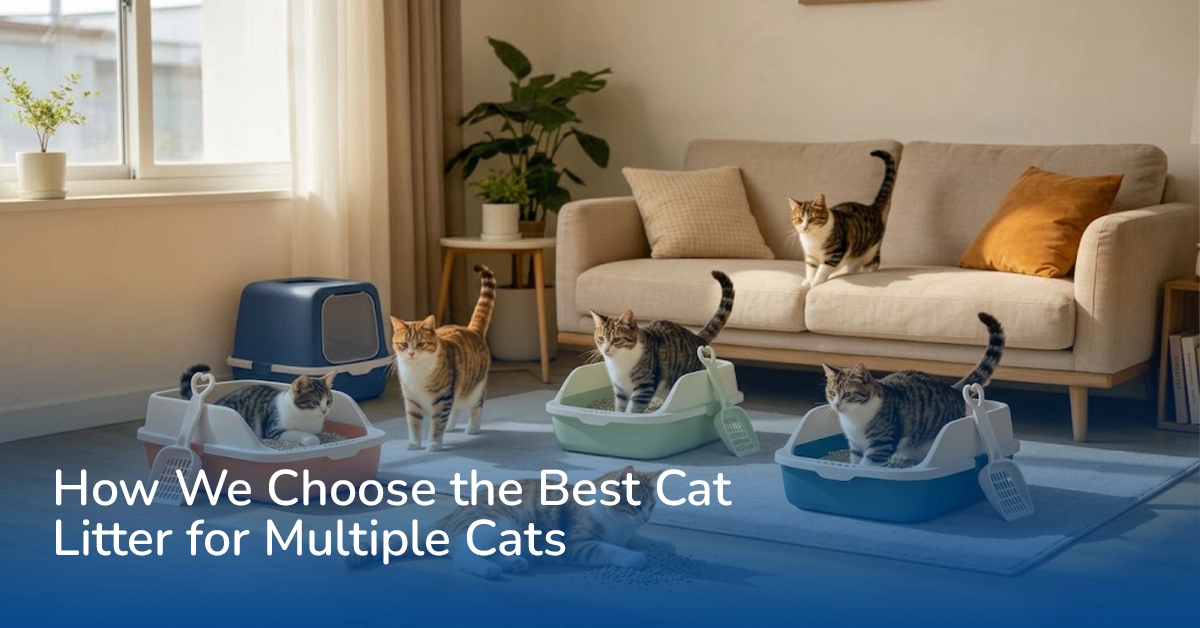
Choosing the best cat litter for multiple cats requires more than comparing fragrance, packaging, or price. A multi-cat home creates more litter-box traffic, more urine and solid waste, faster odor buildup, and greater litter consumption. That means we look at clumping strength, absorption, odor control, dust, tracking, cat acceptance, pack size, cost per use, and availability in Pakistan before deciding whether a litter is suitable for a multi-cat household.
At Purr Pet Food, the goal is not to assume that one litter is perfect for every cat. Instead, the right choice should balance:
Litter Performance + Cat Preference + Household Size + Cleaning Routine + Practical Cost
The main difference between a single-cat and multi-cat household is the amount of use each litter box receives.
The relationship is simple:
More Cats → More Litter-Box Visits → More Waste & Moisture → Faster Odor Buildup → More Frequent Cleaning
Because of this, cat litter guide for several cats needs to perform consistently under heavier use.
When comparing options, we look for litter that can:
A package labelled “multi-cat” is not automatically better. The actual litter characteristics matter more than the marketing label.
We evaluate multi-cat litter as a combination of related attributes rather than judging it by one feature.
Clumping strength is particularly important in homes where litter boxes are used frequently.
A good clumping process looks like this:
Urine → Absorption → Firm Clump → Clean Scoop
A poor one looks like:
Urine → Weak Clump → Breakage During Scooping → Soiled Particles Left Behind
When clumps break apart easily, small contaminated particles can mix back into otherwise clean litter. This may make the box harder to maintain and can increase how much litter needs to be replaced.
When comparing the best clumping cat litter, look beyond whether the product simply says “clumping.” Clump integrity during scooping matters too.
Absorption describes how effectively litter takes up moisture.
For multi-cat households, this matters because boxes can receive repeated use throughout the day.
Efficient absorption helps contain urine within a smaller area so the litter can form a manageable clump rather than allowing moisture to spread through a larger section of the litter bed.
Absorption and clumping are related, but they are not exactly the same attribute.
A litter can absorb moisture while still producing a weak or oversized clump.
Odor is one of the biggest concerns for households with several cats, but strong fragrance should not automatically be confused with strong odor control.
Effective litter-box odor management depends on:
Absorption + Waste Removal + Clean Litter + Enough Boxes + Regular Cleaning
Scented litter may change how the area smells, but fragrance cannot replace removing urine clumps and feces.
When evaluating litter, we therefore consider its practical odor performance separately from its added scent.
Dust can appear when litter is:
The amount can vary between products, including products made from similar materials.
For that reason, claims such as “dust-free” should not automatically determine the recommendation. The actual formula, granule characteristics, and product specifications matter.
Tracking happens when litter particles leave the box on a cat’s paws or fur.
It is influenced by several factors:
Particle Size + Particle Weight + Cat’s Paws/Fur + Digging + Box Design
Very fine or lightweight particles may behave differently from heavier granules, but there is no single litter texture that completely eliminates tracking for every cat.
A litter mat and suitable box setup can also help keep loose particles around the litter area.
This is one of the easiest factors to overlook.
A litter can have excellent clumping and odor performance but still be a poor choice if the cats refuse to use it.
Cats can respond differently to:
For a multi-cat household, this becomes more complicated because one cat may accept a litter that another dislikes.
The goal is therefore not simply:
Best Performing Litter
It is:
Good Performance + Acceptance by the Cats Using It
Multiple cats generally consume more litter than one cat.
That makes pack size an important practical consideration.
Larger packs may reduce how often litter needs to be reordered, but a large bag is not automatically better value. Weight, storage space, product performance, and actual consumption should also be considered.
The lowest-priced bag is not necessarily the cheapest litter to use.
Start with:
Pack Price ÷ Pack Size = Basic Unit Cost
But practical value also depends on:
Unit Cost + Litter Removed Per Scoop + Replacement Frequency + Number of Cats
For example, if a low-priced litter creates weak clumps that remove large amounts of surrounding clean litter, the household may go through the bag faster.
That is why we consider cost per use, not simply shelf price.
A litter is not especially practical if owners cannot reliably buy it again.
For Pakistan cat owners, we also consider:
Availability matters even more when several cats are consuming litter regularly.
Clumping should be evaluated consistently rather than judging a litter by marketing language.
Important questions include:
The important relationship is:
Strong, Compact Clump → Easier Waste Removal → Less Clean Litter Lost
However, litter performance can also be affected by the amount of litter in the box.
A very shallow litter bed can allow urine to reach the bottom before being fully absorbed, which may result in sticking.
A very large clump is not automatically a sign of better performance.
If one urine event causes a large amount of surrounding clean litter to become attached to the clump, more usable litter may be discarded during every cleaning.
For a multi-cat household, those small losses can accumulate.
So the ideal result is not simply a hard clump.
It is a firm, manageable clump that removes contaminated litter efficiently without unnecessarily wasting clean material.
Odor control should be assessed as part of the entire litter-box system.
Consider:
Litter Performance → Waste Removal → Number of Boxes → Cleaning Frequency → Ventilation
This is why comparing two litters solely by smell immediately after opening the bags does not tell you which one manages a multi-cat box better.
A heavily fragranced litter may smell stronger initially while another formula may rely more on absorption and odor-control materials.
The important question is how effectively the litter supports a clean box during normal use.
Several cats can mean more digging, more litter-box visits, and more particles leaving the box.
Consider dust during:
Consider how far particles travel from the box and whether they easily remain attached to paws or fur.
These characteristics affect household cleanliness, but neither should be evaluated in isolation.
For example, switching to a larger particle purely to reduce tracking is not useful if the cats dislike walking on it.
Both scented and unscented litter can work in multi-cat households.
Scented formulas contain added fragrance designed to alter or mask perceived odor.
They may appeal to owners who prefer fragrance around the litter area.
Unscented formulas do not rely on added perfume.
They may be preferable for cats or owners who dislike strong fragrances.
The important distinction is:
Scent ≠ Odor Removal
Regardless of which type you choose, waste still needs to be removed regularly.
When comparing options, evaluate actual odor performance and cat acceptance separately from fragrance.
Bentonite is commonly used in clumping cat litter because of its ability to absorb moisture and bind together.
The basic process is:
Moisture → Bentonite Absorption → Particle Binding → Clump Formation
That can make bentonite useful for multi-cat homes where frequent scooping is necessary.
Potential advantages include:
However, bentonite formulas can differ significantly in:
Therefore:
Bentonite ≠ Automatically High-Quality Litter
The individual formula still needs to be evaluated.
Cat owners interested in this material can compare Purr Pet Food’s imported bentonite cat litter options.
Cat litter selection is partly a product decision and partly a behavioral decision.
Cats may develop preferences for certain textures or scents. A sudden switch from one material to another can sometimes result in hesitation or avoidance.
For example:
Fine Unscented Litter → Cat Comfortable
Changing immediately to:
Large, Strongly Scented Granules → Different Texture + Different Smell
may be a bigger behavioral change than it appears to the owner.
When switching litter, monitor:
If a cat suddenly stops using the litter box, do not assume the litter is the only possible cause. Box cleanliness, location, stress, conflict with another cat, and medical problems can also contribute.
Even excellent litter cannot compensate for too few litter boxes.
A commonly used starting guideline is:
Number of Cats + One Additional Litter Box
For example:
| Number of Cats | Common Starting Point |
| 1 | 2 boxes |
| 2 | 3 boxes |
| 3 | 4 boxes |
| 4 | 5 boxes |
This is a guideline rather than a strict rule for every home.
Also consider:
Where practical, distribute boxes across useful locations instead of placing every box directly beside the others.
Explore appropriate litter boxes when planning a multi-cat setup.
Multi-cat litter boxes generally need more frequent attention because waste accumulates faster.
Check boxes at least daily and clean them according to actual usage. Heavily used boxes may require more frequent scooping.
A better formula than following one rigid schedule is:
Number of Cats + Number of Boxes + Actual Usage = Scooping Frequency
A suitable litter scoop can make firm urine clumps and solid waste easier to remove.
There is no single full-replacement schedule that works for every multi-cat household.
Three maintenance tasks should be separated.
Remove urine clumps and feces frequently.
Replace clean litter lost during scooping to maintain an appropriate litter level.
Empty the remaining litter and clean the box when needed according to the litter’s condition, usage, and manufacturer instructions.
Replacement frequency depends on:
Daily scooping is not the same as completely replacing the litter.
Multi-cat households can use litter quickly, making long-term value particularly important.
We recommend comparing four things.
Calculate:
Pack Price ÷ Pack Size
This makes differently sized bags easier to compare.
How much litter leaves the box with each urine clump?
How quickly does the remaining litter become difficult to maintain?
How many cats and litter boxes are using the product?
The more useful calculation is therefore:
Unit Cost + Waste Per Scoop + Replacement Rate + Household Usage = Practical Litter Cost
This approach is more meaningful than simply choosing the cheapest bag.
Imported litter should not automatically be considered better, and locally manufactured litter should not automatically be considered lower quality.
Instead, compare the same attributes:
| Factor | What to Compare |
| Clumping | Strength and breakage |
| Absorption | Moisture containment |
| Odor | Performance during actual use |
| Dust | Pouring and scooping |
| Tracking | Particles outside box |
| Cat Acceptance | Texture and scent |
| Pack Size | Household requirements |
| Cost | Practical cost per use |
| Availability | Ability to reorder consistently |
A product should earn a recommendation based on how well it meets the household’s requirements rather than its country of origin.
Instead of looking for one universal winner, match litter characteristics to your biggest problem.
Prioritize:
Prioritize:
Do not judge odor control only by fragrance.
Compare lower-dust formulas while still considering clumping and cat acceptance.
Compare:
Cost Per Unit + Consumption + Waste Per Scoop
rather than simply buying the cheapest bag.
Consider unscented formulas and monitor how the cats respond.
Prioritize acceptance and consider whether different litter boxes need different setups rather than forcing every cat to use exactly the same option.
Strong perfume does not replace cleaning.
Evaluate the actual product characteristics.
Calculate practical consumption and cost per use.
Weak clumps can make daily cleaning less efficient.
A shallow litter bed can allow urine to reach the bottom and create sticking.
A technically excellent litter provides little value if cats refuse to use it.
Litter performance cannot solve an inadequate box setup.
Some cats need time to adapt to a different texture or fragrance.
A sudden change can be associated with the litter or environment, but it can also indicate a health problem.
At Purr Pet Food, choosing the best cat litter for multiple cats should be based on more than a label or price tag. The most useful recommendation comes from understanding the relationship between clumping performance, absorption, odor management, dust, tracking, cat preference, household usage, cost, and availability.
If you’re ready to compare specific products rather than selection criteria, see our guide to the best clumping cat litter for multiple cats or browse available cat litter options for your multi-cat household.
WhatsApp us