
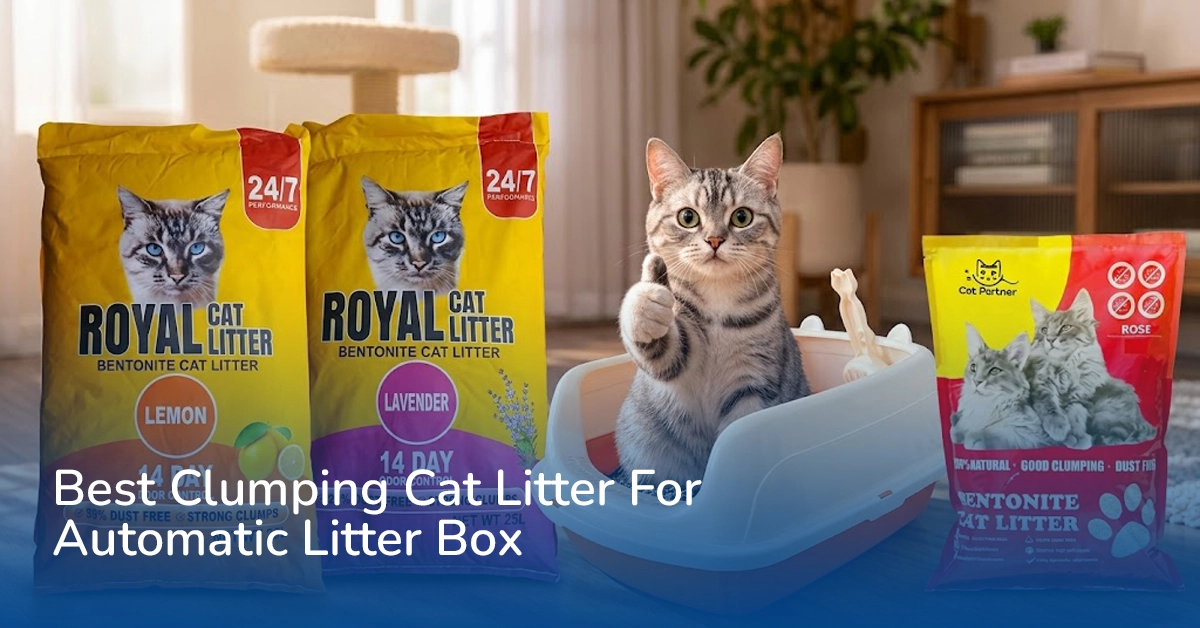
The best clumping cat litter for an automatic litter box is usually a fast-clumping formula that creates firm, scoopable clumps, produces manageable dust, and has a particle size compatible with the machine’s cleaning system. However, not every automatic litter box accepts the same litter, so always check the manufacturer’s litter requirements before switching.
For automatic boxes, choosing litter is not only about your cat’s preference. The litter also has to work correctly with the machine.
Automatic Litter Box → Compatible Litter → Fast Absorption → Firm Clump → Cleaning Cycle → Waste Separation
This guide explains what to look for, which litter characteristics matter most, and how to avoid common problems such as broken clumps, sticking, excessive litter waste, dust, and tracking.
For most automatic litter boxes designed to use clumping litter, look for a formula with:
The first consideration, however, should always be machine compatibility.
Some automatic litter boxes sift litter through a screen, while others rotate a drum or use another waste-separation mechanism. A litter that performs well in one design may not necessarily be appropriate for another.
Before buying, check:
If you are still comparing litter types in general, read our complete cat litter guide before choosing a formula for an automatic box.
With a traditional litter box, you decide when to scoop. That gives wet litter more time to absorb moisture and form a stable clump.
An automatic box works differently.
Cat Uses Box → Litter Absorbs Moisture → Clump Forms → Cleaning Cycle Starts → Waste Is Separated
If the litter does not perform properly during this process, problems can occur.
For example:
Slow Clumping → Cleaning Starts Too Soon → Wet Clump Breaks or Smears
Or:
Weak Clump → Mechanical Movement → Clump Breaks → Soiled Particles Return to Litter
This is why the best litter for an automatic box needs to work with both the cat and the cleaning mechanism.
Clumping speed matters because an automatic cleaning cycle may begin after your cat leaves the box.
The litter needs enough time to absorb urine and form a stable clump before waste separation starts.
This does not mean every automatic box requires litter to clump within a specific number of seconds. Cycle timing varies by machine.
Instead, look for a litter that forms stable clumps within the operating conditions recommended for your box.
Clump strength is one of the most important qualities to compare.
A firm clump is less likely to fall apart as the machine rotates, rakes, or sifts the litter.
The ideal relationship is:
Absorption → Firm Clump → Successful Separation → Clean Litter Remains
Weak clumps can create the opposite result:
Weak Clump → Breakage → Contaminated Particles → More Odor & Litter Waste
A good best clumping cat litter choice should therefore be based on clump quality, not simply whether the package says “clumping.”
Particle size can influence how effectively litter moves through an automatic cleaning system.
Depending on the machine, granule size may affect:
There is no universal granule size that works with every automatic litter box.
Follow the machine manufacturer’s requirements rather than choosing based on particle size alone.
Dust is important in both manual and automatic litter boxes, but automatic cleaning introduces another source of litter movement.
Dust can be disturbed during:
Look for products designed to keep dust manageable, but be careful with absolute claims such as “100% dust-free.”
Tracking happens when litter particles leave the box on your cat’s paws or fur.
Automatic cleaning does not eliminate this problem.
Tracking can depend on:
Particle Size + Particle Weight + Cat’s Paws/Fur + Digging + Box Exit Design
A litter mat and suitable box placement can help even when using a low-tracking formula.
Automatic litter boxes can remove waste from the active litter bed after use, but that does not mean odor disappears automatically.
Odor management still depends on:
The best formula should manage odor without relying entirely on strong fragrance.
Rather than choosing a product because it says “premium” or “automatic litter box compatible,” compare the attributes that affect real performance.
| Feature | What to Look For | Why It Matters |
| Compatibility | Approved for your machine | Prevents operating problems |
| Clumping speed | Forms stable clumps efficiently | Helps before cleaning begins |
| Clump strength | Firm, cohesive clumps | Reduces breakage |
| Granule size | Suitable for the machine | Supports sifting/separation |
| Dust | Manageable during movement | Important during repeated cycles |
| Tracking | Particles stay near the box | Keeps surrounding area cleaner |
| Odor control | Effective without relying only on perfume | Important between maintenance |
| Cat acceptance | Suitable texture and scent | Cats still need to use it |
| Cost per use | Low unnecessary litter waste | Important for long-term use |
When comparing actual products, verify both the litter specifications and your automatic litter-box manufacturer’s instructions.
Bentonite is widely used in clumping cat litter because it absorbs moisture and binds wet particles into removable clumps.
The process is:
Urine → Bentonite Absorbs Moisture → Particles Bind → Clump Forms
This clumping ability can make bentonite relevant for many automatic litter boxes designed specifically for clumping clay litter.
Potential advantages include:
However, bentonite formulas can differ in:
Do not assume every bentonite litter works in every machine.
If your automatic box permits bentonite-based litter, you can compare Purr Pet Food’s imported bentonite cat litter options.
When comparing clumping vs non clumping cat litter, the cleaning mechanism of the automatic box becomes especially important.
Clumping litter creates removable masses after absorbing urine.
Many automatic sifting systems are designed around this process:
Loose Clean Litter → Passes Through/Returns
Clumped Waste → Separated → Waste Compartment
This can allow clean litter to remain available for reuse.
Non-clumping litter absorbs moisture without forming the same firm urine clumps.
It should not automatically be used in a machine designed specifically for clumping litter.
Some automatic systems may use different litter technologies, so always follow the instructions for the individual machine.
Choosing between scented vs unscented cat litter is partly about household preference and partly about your cat.
Contains added fragrance intended to change or mask perceived litter-box odor.
Does not rely on added fragrance and may suit cats or owners who dislike strong scents.
Remember:
Fragrance ≠ Odor Removal
An automatic box still requires:
Strong fragrance should not be used to hide poor maintenance.
Sometimes but not universally.
Plant-based litter can differ substantially in:
A tofu litter that performs well in a manual litter tray may not necessarily pass correctly through the screen or waste-separation mechanism of an automatic box.
Check whether your machine specifically allows that material before using it.
The same principle applies to other alternatives such as wood, corn, paper, pellets, and crystal litter.
Material Type Alone ≠ Automatic Box Compatibility
Only if the specific automatic litter box is designed or approved for it.
Crystal litter handles moisture differently from conventional clumping clay. Some automatic systems are designed around particular crystal products, while others require clumping litter.
Do not replace a manufacturer’s recommended litter with crystal litter simply because it provides good absorption.
For anyone wondering how much cat litter to put in litter box, an automatic model requires a slightly different answer:
Follow the machine’s fill line and manufacturer instructions first.
Adding more litter does not necessarily improve performance.
Insufficient litter can potentially lead to:
Overfilling can potentially:
Automatic boxes are engineered around particular operating conditions, so the correct fill level matters.
An automatic litter box reduces manual scooping, but it does not eliminate litter maintenance.
When asking how often to change cat litter, separate four different jobs.
The machine removes waste according to its cleaning cycle.
Fresh litter may need to be added as litter is gradually removed with waste.
The waste compartment needs to be emptied according to usage and manufacturer instructions.
Eventually, the remaining litter and internal surfaces need maintenance.
Frequency depends on:
Automatic Cleaning ≠ Maintenance-Free
The best cat litter for multiple cats needs to handle more frequent litter-box use and more cleaning cycles.
The relationship is:
More Cats → More Waste → More Automatic Cycles → Greater Litter Consumption
For a multi-cat automatic setup, prioritize:
Also confirm that the automatic litter box itself is appropriate for the number, age, and size of cats using it.
For more detail on multi-cat litter performance, read our guide to the best cat litter for multiple cats.
Clumps may break if they have not formed strongly enough before the cleaning cycle starts.
Possible factors include:
When clumps break, small contaminated pieces may mix back into the clean litter.
Before changing settings or litter, check the manufacturer’s instructions for both the recommended litter and cleaning-cycle options.
Sticking can have several possible causes.
These may include:
Do not immediately assume the machine is defective.
Check:
Litter Compatibility → Fill Level → Clump Quality → Cycle Timing → Machine Cleanliness
If clean litter repeatedly enters the waste drawer, possible factors include:
Start with the manufacturer’s recommended litter and fill level.
Changing several settings at once makes troubleshooting more difficult.
| Problem | Possible Cause | What to Check |
| Clumps break | Weak or slow clumping | Litter formula and cycle timing |
| Wet waste smears | Cycle starts before stable clump | Clumping performance |
| Clumps stick | Fill level or absorption issue | Litter level and formula |
| Clean litter is discarded | Particle/sifting incompatibility | Manufacturer requirements |
| Excess dust | Dusty litter formula | Product specifications |
| Strong odor | Waste drawer or old litter | Maintenance routine |
| Heavy tracking | Fine/light particles | Litter, mat and box exit |
| Cat avoids box | Texture, scent, machine or location | Cat behavior and setup |
If your cat suddenly avoids the automatic box, do not assume litter is the only possible cause. Noise, movement, location, cleanliness, stress, another cat, or a health problem may also contribute.
Switching litter involves two questions:
First verify that the new litter is compatible with the machine.
If your cat is sensitive to litter changes and manufacturer guidance permits mixing during transition, introduce the new litter gradually.
A typical transition may look like:
Current Litter → Small Amount of New Litter → Increase Gradually → Monitor
Watch both:
Look for:
Look for:
Do not mix litter formulas if the automatic litter-box manufacturer advises against it.
Even the best automatic litter box does not necessarily stop tracking.
Try:
Do not sacrifice machine compatibility simply to get larger or heavier granules.
For automatic litter boxes, the cheapest bag may not provide the lowest long-term cost.
Start with:
Pack Price ÷ Pack Size = Basic Unit Cost
Then consider:
Unit Cost + Litter Lost With Waste + Cleaning Efficiency + Number of Cats = Practical Cost
For example, if weak clumps repeatedly break or large amounts of clean litter enter the waste drawer, litter consumption may increase.
When comparing cat litter, consider:
This is especially important for multi-cat households, where litter consumption can be substantially higher than in a single-cat home.
Clumping ability alone does not guarantee machine compatibility.
The automatic litter-box manufacturer’s requirements should come before generic online advice.
More litter is not automatically better and may interfere with some cleaning systems.
Odor control depends on litter performance and maintenance.
Waste drawers, litter levels, internal surfaces, and the remaining litter still require attention.
Consider actual consumption and waste.
Machine compatibility does not matter if your cat refuses to use the litter.
If possible, avoid introducing too many changes simultaneously. It becomes harder to identify why your cat or machine is having problems.
The best clumping cat litter for an automatic litter box is not simply the litter with the strongest marketing claims. It is the formula that works with the machine’s cleaning mechanism, creates stable clumps, separates efficiently, suits your cat, and remains practical to maintain.
Before ordering, confirm your automatic litter box’s compatibility requirements, then compare suitable options from Purr Pet Food’s cat litter range.
WhatsApp us