
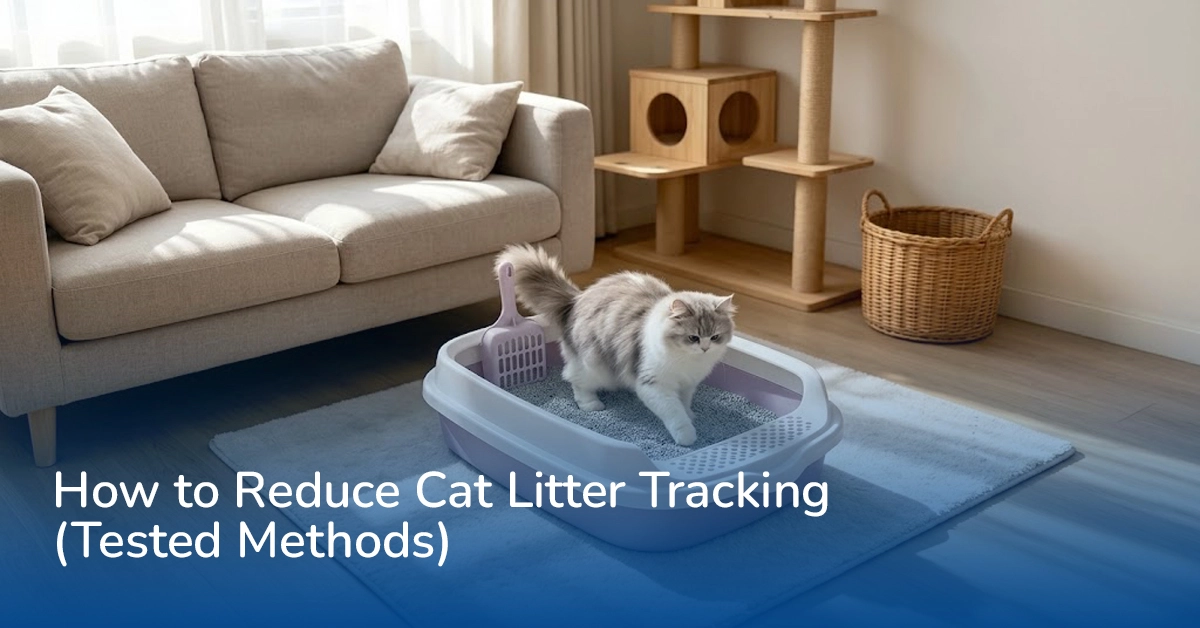
To reduce cat litter tracking, place a textured litter mat outside the box, choose litter that doesn’t easily stick to your cat’s paws, and use a spacious tray that helps contain scattered granules. Keeping the surrounding floor clean and adjusting the litter depth can also make a noticeable difference.
If you have a cat, you’ve probably experienced this: you clean the litter box, sweep the floor, and a few minutes later, tiny litter particles appear across the room again.
This happens because litter can stick to your cat’s paws, get caught in its fur, or scatter when your cat digs. The problem can be especially frustrating in homes with tiled floors, where small granules spread easily and collect in corners.
The good news is that you don’t need to change your entire litter box setup. A few practical adjustments can help keep more litter where it belongs.
If you’re tired of finding litter across your floors, start with these simple changes:
These methods work best when you first identify how the litter is leaving the box.
For example, if litter collects in a pile beside the tray, your cat may be kicking it out while digging. If granules appear several feet away, they may be travelling on your cat’s paws.
Cat litter tracking happens when loose particles leave the litter box and spread across nearby surfaces.
However, not all litter on the floor comes from the same cause.
Cats naturally dig and cover their waste after using the litter box.
During this process, small granules can become trapped between their toes or cling to their paw pads.
When the cat walks away, those particles fall onto the floor.
Fine litter particles may be particularly noticeable because they can travel beyond the immediate litter box area.
Moisture on paws or damp litter can also contribute to particles sticking.
Some cats dig enthusiastically before or after using the litter box.
If the tray is small, shallow, or filled close to the edge, granules may be kicked onto the surrounding floor.
This is technically litter scatter rather than paw tracking, but both problems contribute to the same mess.
A larger tray or suitable higher-sided box may help contain scattered material.
Long-haired cats may carry litter in the fur around their paws.
Loose particles can become trapped in paw tufts and fall off as the cat moves around the house.
This is more noticeable when litter is damp or has a texture that clings easily.
Regular grooming and suitable litter selection may help reduce the problem.
A litter mat is one of the simplest tools for catching loose granules before they spread across your home.
Textured mats are designed to collect particles as cats walk across them.
Some have grooves or mesh-like surfaces that trap litter, while others use a double-layer design that collects granules underneath the top surface.
How to use a litter mat effectively:
A very small mat may not help much if your cat jumps over it.
Observe how your cat exits the tray and position the mat accordingly.
Practical tip: If your cat dislikes walking on a rough mat, try a softer texture rather than forcing it to use an uncomfortable surface.
The litter material itself can affect how much mess appears outside the box.
Particle size, weight, texture, and dust levels all influence how litter behaves.
Very fine granules may become trapped between paw pads, while lightweight particles can scatter more easily during digging.
However, larger granules are not automatically better. Some cats dislike coarse textures and may avoid the litter box if the material feels uncomfortable.
When comparing litter, look for:
If you’re considering different formulations, explore Pakistan-manufactured cat litter available through Purr Pet Food.
Choose litter based on its actual characteristics rather than assuming that a product labelled “low tracking” will work equally well for every cat.
A litter box that is too small can make digging and turning difficult.
When your cat doesn’t have enough space, litter may be pushed over the sides.
A larger tray gives your cat more room to move and cover its waste.
As a general starting point, many cat-care recommendations suggest choosing a box approximately one and a half times your cat’s body length, measured from the nose to the base of the tail.
The box should allow your cat to enter, turn around, and dig comfortably.
Avoid choosing a smaller tray simply because it fits better in a tight corner.
A spacious, accessible box is more important than saving a little floor space.
If your cat regularly kicks litter over the edges, a tray with higher sides may help contain it.
Higher walls can reduce the amount of litter scattered during digging.
However, they aren’t suitable for every cat.
Kittens, senior cats, and cats with arthritis or mobility difficulties may struggle to enter boxes with high sides.
A practical compromise: Choose a box with higher walls around most of the tray and a lower entrance.
This can help contain scattered litter while keeping access comfortable.
Covered litter boxes may also reduce some scatter, but they can trap odours and may not be accepted by every cat.
Never sacrifice accessibility or your cat’s comfort just to reduce tracking.
Where your cat walks after leaving the litter box can affect how far loose granules spread.
A clear, easy-to-clean exit area makes it simpler to collect tracked litter.
Try placing the tray on a suitable washable surface with a litter mat directly outside the entrance.
Avoid placing the box immediately beside thick carpets or difficult-to-clean fabrics when another suitable location is available.
If the box sits on a tiled floor, check nearby grout lines and corners where particles may collect.
Make sure the setup doesn’t create an obstacle course that discourages your cat from using the tray.
Also check whether litter is sticking because the material is damp. If so, improving litter maintenance may be more useful than grooming alone.
Even with a suitable mat and litter box, some particles may escape.
A simple cleaning routine can prevent loose litter from spreading further.
Use a vacuum or suitable cleaning tool to remove dry granules, including particles trapped along grout lines.
Vacuum carefully using equipment suitable for the carpet and litter material.
Empty collected granules and clean the mat according to the manufacturer’s instructions.
Avoid sweeping dusty litter aggressively if it creates airborne particles.
If litter has become wet or contaminated with urine or faeces, dispose of it hygienically rather than returning it to the tray.
Every cat uses its litter box differently.
Some dig gently, while others kick litter in several directions.
Some walk slowly out of the box, while others jump straight over the mat.
Observing your cat can help you identify which solution is most likely to work.
For example:
The goal is to reduce tracking without making the litter box unpleasant for your cat.
There isn’t one litter material that consistently produces the least tracking in every household.
The amount of tracking depends on the product’s particle characteristics, the litter box setup, and your cat’s behaviour.
Understanding the differences can help you choose a suitable option.
Bentonite is commonly used in clumping cat litter.
It absorbs moisture and forms clumps that can be removed during daily scooping.
Some bentonite products contain fine granules that may stick to paws, while others use different particle sizes or formulations.
Things to consider:
Tofu litter is generally made from processed plant-based materials and is often sold in pellet-like forms.
Its particle shape differs from fine-grain clay litter.
Some formulations may be less likely to lodge between paw pads, but tracking still depends on the specific product and cat.
Things to consider:
Silica crystal litter is another alternative.
Crystal size and shape vary by formulation, which can affect how particles move and feel beneath a cat’s paws.
Some cats accept crystal litter comfortably, while others prefer softer materials.
Things to consider:
| Litter Type | Tracking Considerations | Other Factors |
| Fine-grain bentonite | Small particles may cling to paws | Clumping, dust, texture |
| Larger-grain clay | May reduce some paw adhesion | Comfort and scatter |
| Tofu pellets | Different shape and particle size | Cat acceptance, clumping |
| Silica crystals | Depends on crystal size and texture | Comfort, absorbency |
| Low-dust formulations | May produce less airborne dust | Not necessarily low tracking |
Important: Low-dust and low-tracking litter are not the same thing. Dust refers to fine airborne particles, while tracking refers to granules carried or scattered outside the box.
Cat litter mats can help reduce the amount of loose litter spreading through a home, but their effectiveness depends on design and placement.
A mat works by collecting particles that fall from your cat’s paws as it leaves the box.
However, a mat won’t prevent litter from being kicked over the sides of a tray.
Look for a mat that:
Position it where your cat naturally steps after leaving the box.
For a front-entry tray, this is usually directly outside the entrance.
If your cat frequently exits from different directions, a larger mat or wider washable floor covering may be useful.
No mat can guarantee that all litter stays near the box.
Some cats jump over mats, and particles can remain trapped in fur or paws.
A mat is most useful when combined with appropriate litter, a comfortable tray, and regular cleaning.
In apartments and smaller homes, litter tracking can become noticeable because the tray may be close to living areas.
A practical setup should make cleaning easier without limiting your cat’s access.
Place the litter box in an area where your cat can enter and leave comfortably.
Avoid busy walkways, loud appliances, and locations where the door may be closed unexpectedly.
A bathroom or utility area can work if it remains accessible and adequately ventilated.
A washable floor surface makes it easier to remove scattered litter.
In homes with tiled floors, a suitable litter mat can help collect particles before they spread into nearby rooms.
Check corners and grout lines during routine cleaning.
Some cat owners place litter boxes on balconies to keep mess away from living spaces.
However, an exposed balcony may create risks involving heat, rain, unsafe access, or falls.
Choose a secure indoor location whenever possible.
Don’t place the tray inside a narrow enclosure solely to prevent tracking.
Your cat should have enough room to enter, turn around, dig, and leave without feeling trapped.
A comfortable litter box is more important than a completely litter-free floor.
You don’t need complicated equipment to observe whether a change is helping.
A simple comparison can show whether litter is spreading less than before.
Clean the floor around the litter box and note where particles usually appear.
Take a photograph if helpful.
For example, introduce a larger litter mat while keeping the same litter and tray.
Changing several things simultaneously makes it difficult to identify which adjustment helped.
Watch how your cat enters, digs, and exits.
Do not interrupt or force your cat to use an unfamiliar setup.
After a consistent observation period, check how much litter has collected outside the box.
Consider whether the new setup is easier to clean and whether your cat remains comfortable using it.
If the mat doesn’t help because your cat jumps over it, try a different position or size.
If the problem is digging scatter, changing the tray may be more effective than adding another mat.
Remember: A method that works for one cat may not work equally well for another.
A tiny mat may catch only a few particles before your cat steps onto the floor.
Choose enough coverage for your cat’s usual exit path.
Excess litter can be kicked over the edges during digging.
Maintain a suitable depth rather than filling the tray to the top.
A cramped box may increase scatter because your cat has limited room to move.
Choose a tray that allows comfortable digging and turning.
A new litter texture may reduce tracking but discourage your cat from using the box.
Introduce changes carefully and maintain a familiar option when possible.
If your cat begins avoiding the tray, review our guidance on why cats stop using the litter box once the dedicated article is published and its URL is verified.
A mat cannot solve every problem.
Observe whether litter is being carried on paws, kicked out during digging, or trapped in fur.
Match the solution to the cause.
Reducing cat litter tracking starts with understanding how the particles leave the tray.
If litter sticks to your cat’s paws, focus on the material and exit area. If your cat kicks litter out while digging, review the tray size, side height, and litter depth.
A good litter mat can help capture loose granules, but it works best as part of a comfortable, easy-to-maintain litter box setup.
For cat owners in Pakistan, especially those living in apartments with tiled floors, a few thoughtful changes can make everyday cleaning much easier.
At Purr Pet Food, we understand that litter preferences differ from one cat to another. The right choice should balance cleanliness, ease of maintenance, and your cat’s comfort.
The goal isn’t to eliminate every stray granule. It’s to create a cleaner home while keeping your cat comfortable using its litter box.
WhatsApp us